

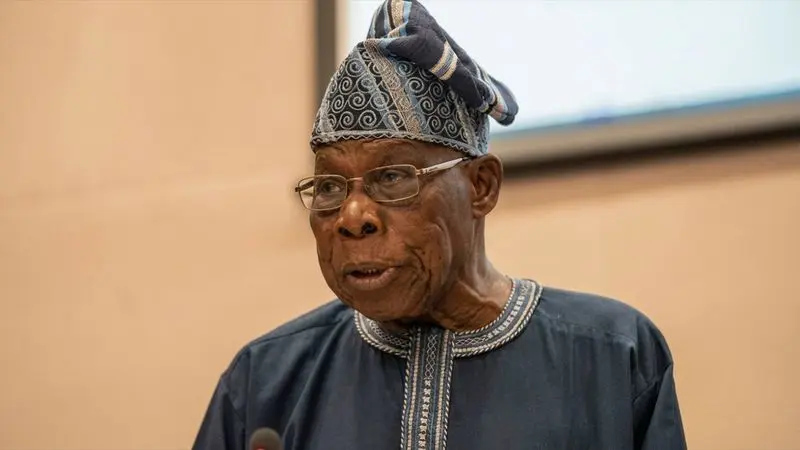
Former President Olusegun Obasanjo has declared that any government that fails to guarantee the security of life and property has no justification to exist, delivering a stark assessment of Nigeria’s worsening insecurity and the leadership challenges confronting the country.
Obasanjo blamed Nigeria’s deepening challenges on poor leadership, warning that the country has lost its influence in international affairs and mishandled key regional relationships, particularly within the Economic Community of West African States (ECOWAS).
In an interview on News Central’s Soni Irabor Live (SIL) at the weekend, Obasanjo also said Nigeria was no longer “at the table” of global decision-making, stating that the country’s inability to shape events beyond its borders reflects a broader leadership deficit.
On the pervasive insecurity in Nigeria, the outspoken ex-leader of Africa’s most populous nation maintained that the citizens must not accept kidnapping and other social vices as a norm, referencing how Nigerians could travel across the country in the past.
He delivered a scathing assessment of the federal government, stating that any administration that fails to guarantee the safety of life and property has effectively forfeited its right to exist.
Obasanjo traced the roots of Nigeria’s worsening security situation to the aftermath of the civil war, when arms proliferation was not properly controlled. He said the problem had since escalated due to poor governance and neglect.
He also linked the crisis to external and internal factors, including the return of armed mercenaries following the fall of Libya’s former leader, Muammar Gaddafi, as well as the use of armed groups for political purposes.
Obasanjo warned that the growing number of out-of-school children, estimated to be about 20 million, posed a long-term security risk, describing it as a ready pool for future recruitment into extremist groups.
The former president stated, “The other day, somebody came to me and said, well, from NIPSS (National Institute for Policy and Strategic Studies), they were looking into the causes of insecurity. And I said, what is this about? He said the government has asked them to do this.
“I said, well, this government, will they have the courage to implement whatever you will get. He said he didn’t know. And I said, look, I came back to this country in 1959 after my military training, initial military training in the UK. You could go anywhere in the North. Anywhere. And what you will get is people being gracious there.
“And somebody was telling me the other day that, look, we’ve taken it (kidnapping) for granted. It’s no longer news. So when you hear that somebody in your family has been kidnapped, you all come together. Even for N2,000, maybe they can release him. Should we accept that as a way of life? No way.”
Obasanjo emphasised, “And the first responsibility of any government, no matter how that government comes into being, is the security of life and property. A government that cannot give security of life and property to its citizens has forfeited the right of existence.”
The former president expressed pessimism about Nigeria’s current direction, stating bluntly, when asked about the country’s prospects under the present leadership, that he “sees nothing”. He stated that the erosion of democratic values, including what he described as the substitution of a “selectorate” for a true electorate, had weakened accountability and governance.
Obasanjo specifically criticised the Tinubu administration’s handling of relations with neighbouring Niger Republic following the recent coup in that country, describing the response as ill-conceived and damaging to decades of regional cooperation painstakingly built over 50 years.
He said Nigeria’s actions, including border closures, cutting electricity supply and financial restrictions, undermined long-standing historical, economic and cultural ties between the two countries.
Obasanjo recalled that Nigeria and Niger shared deep-rooted connections, with significant cross-border familial links, and stressed that cooperation between both countries was once critical to Nigeria’s strategic and military interests.
He maintained that Nigeria’s decisions on the recent crisis in Niger pointed to a lack of understanding at the highest levels of government, insisting that effective leadership is the missing ingredient in Nigeria’s current trajectory. He said while it did not cost much for Nigeria to maintain influence, it required clarity of thought and strategic engagement, which he believed were presently lacking.
As chairman of ECOWAS, Tinubu was believed to have adopted a hard-line stance after the Niger Republic coup, pushing sanctions, border closures, and even threatening military intervention to restore constitutional order.
Critics, including Obasanjo, stated that the situation was poorly handled, and it damaged long-standing ties with Niger, weakening regional cohesion rather than strengthening ECOWAS authority.
Niger, Mali and Burkina Faso eventually left the sub-regional group.
Obasanjo stated, “Today, Nigeria is not at the table (of international politics). What is it that is happening that Nigeria is influencing or impacting, and upon whom is Nigeria impacting.
“Look at the way we have handled ECOWAS. Something that took us 50 years to build. Overnight, we mishandled it. And we have virtually destroyed it.
“It’s leadership. Niger Republic had a coup. Our neighbour. At least 30 per cent of the people of Niger Republic have blood relationship with Nigeria.
“We were building the Kanji Dam. Kanji would have been nonsense. So we told Niger Republic, look, for electricity, when the Kanji Dam is working, we will give you whatever you ask for. That was an obligation on our part.
“Without the Niger Republic, our winning in the civil war would have been hard. We used to get materials through Niger Republic to be ferried to our troops on the war front. Now, for all these, then they had to go. And the first thing we did was to close the border. The next thing we did was to cut their electricity. The next thing we did was to say, no money. With our porous borders!”
Obasanjo stated, “So, when I talk of mishandling, you now see what I was talking about. It doesn’t cost much for Nigeria to be at the table. But it requires understanding. But, honestly, I feel pained. Because I know what Nigeria could do.”
Obasanjo also dismissed the relevance of the National Council of State (NCS), a body of former presidents acting in advisory capacity, describing participation in its meetings as a waste of time. He explained that the body was purely advisory and its recommendations were often ignored, making it ineffective as a platform for meaningful engagement or policy influence.
On the economy and the oil sector, the former president reiterated his long-held position that government-owned refineries under the Nigerian National Petroleum Company Limited (NNPC) would not function efficiently. He cited structural inefficiencies, poor maintenance, corruption, and lack of scale as key reasons for their persistent underperformance.
He revealed that during his time in office, efforts were made to attract private sector participation in refinery operations, including discussions with international oil companies, such as Shell, which declined involvement due to concerns over profitability and operational challenges. He also referenced a previous attempt by billionaire businessman Aliko Dangote to acquire stakes in the refineries, which was later reversed by his successor.
Obasanjo stated that the government had since spent billions of dollars, as much as $16 billion, on the refineries, with little to show, contrasting this with the success of privately driven ventures, such as the Nigeria LNG project, which he cited as evidence that public-private partnerships were more effective.
“See what we are doing now even with the NNPC. NNPC has refineries. And I said to people that it will never work,” he maintained.
On Nigeria’s political structure, the former president warned against the emergence of a one-party state, saying it will be detrimental to the country’s development and democratic health. While acknowledging assurances from the president that he was not interested in a one-party state, he maintained that such a system will not serve Nigeria’s interest.
Obasanjo explained, “He (Tinubu) said he will not want to see a one-party state in Nigeria. He said that. And, as I said, I will for once want to take his word for it. It will be a pity. Because it will not even serve its own purpose.”
Despite the criticisms, Obasanjo expressed a strong belief that Nigeria could still recover, attributing this to what he described as the country’s potential and the resilience of its people.
However, he stressed that meaningful progress would depend on a fundamental shift in leadership quality and governance approach.
Emmanuel Addeh
Follow us on: