

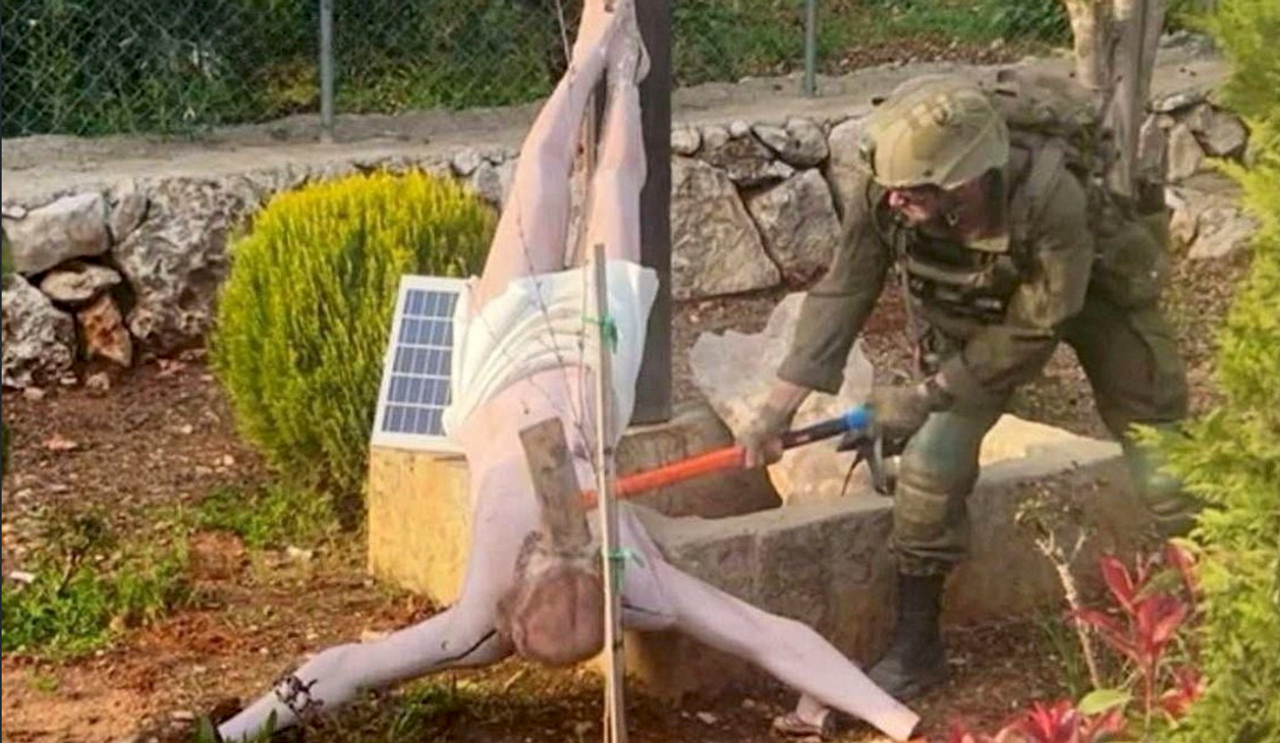
A video emerges of an Israeli soldier vandalising a statue of Jesus in southern Lebanon. The footage spreads quickly. Outrage follows, particularly among Christian communities.
Soon after comes the familiar choreography of official condemnation and media containment: the military distances itself, the act is attributed to an individual soldier, and the story is framed as an isolated incident—an aberration rather than a reflection of institutional culture.
This language matters.
In much of Western media coverage, violence is fragmented into discrete, digestible episodes.
A church is struck in Gaza. A mosque is flattened in Lebanon. A cemetery is bulldozed. A sacred symbol is desecrated. Each event is reported, explained and then sealed off from the next. The effect is to transform accumulation into coincidence.
This is not merely a failure of framing. It is a form of narrative management.
By isolating each act from the wider context of Israel’s genocide in Gaza and its regional escalation, the public is discouraged from recognising patterns of conduct. Systemic behaviour is recast as an anomaly.
Institutional culture is obscured behind the fiction of individual excess.
This pattern of reporting does not deny what happened. It neutralises what happened.
It creates the impression of unfortunate but disconnected mistakes rather than a continuum of destruction.
It turns what may be systemic into something accidental. It encourages audiences to react emotionally to each fresh image while denying them the framework to understand why such images keep appearing.
That is what makes the phrase “isolated incident” so politically useful.
Related
Systematic destruction
For nearly two years, religious and archaeological sites across Gaza and Lebanon have been damaged, desecrated or destroyed. In Gaza, churches that have stood for centuries have been struck during Israeli attacks.
The Church of Saint Porphyrius—one of the oldest churches in the world—was hit in October 2023, killing civilians sheltering inside.
The Holy Family Church, Gaza’s only Catholic church, was also damaged, prompting condemnation from Christian leaders around the world.
Mosques have suffered even more extensively. Hundreds across Gaza have reportedly been destroyed or severely damaged.
Historic sites, including ancient mosques, have been reduced to rubble. In southern Lebanon, mosques and other religious structures have also been hit amid escalating bombardment and cross-border attacks.
Cemeteries, too, have been bulldozed or damaged. Graveyards have been desecrated in ways that carry not only military implications but profound cultural and religious ones.
Yet these incidents rarely enter the same narrative frame.
Each case arrives wrapped in explanation. The site was near militants. The strike was unintended. The intelligence was flawed. The footage lacks context. The act was unauthorised.