

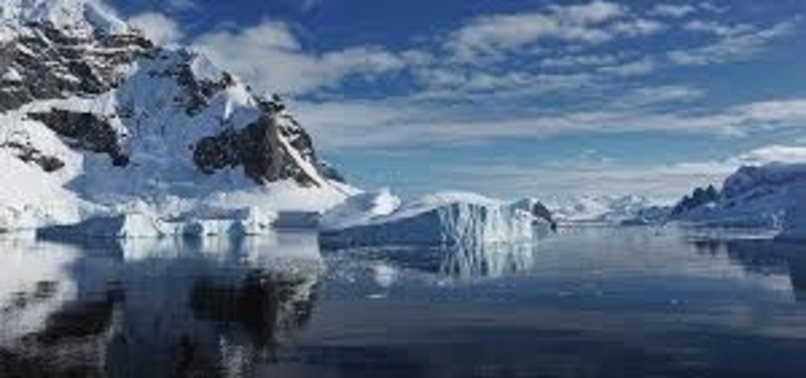
Arctic sea ice reached its annual maximum extent of 14.29 million square kilometers on March 15 this year, slightly below last year’s record low maximum of 14.31 million square kilometers.
This new data reinforces scientists’ findings that the downward trend in winter ice cover is continuing.
This year’s peak ice extent sits approximately 1.3 million square kilometers below the 1981-2010 average, according to the National Snow and Ice Data Center (NSIDC).
Meanwhile, in Antarctica, which has now entered autumn, the summer sea ice annual minimum was recorded at 2.58 million square kilometers on Feb. 26-260,000 square kilometers below the 1981-2010 average. The figure, however, is still above the record low of 1.79 million square kilometers set on Feb. 21, 2023.
– ARCTIC’S CRITICAL WARMING RATE
Speaking to Anadolu, Mahmut Oguz Selbеsoglu, director of Istanbul Technical University’s Polar Research Center, said glaciers and sea ice play a critical role in maintaining the planet’s radiation balance. Simply put, it is the equilibrium that sustains life on Earth.
As ice melts, this balance shifts: evaporation increases, the greenhouse effect intensifies, and global warming accelerates, creating a cycle of continuous ice loss, he said.
Selbesoglu noted that melting is concentrated in marginal ice zones in the Barents Sea, Bering Sea and the peripheral areas of the North Atlantic.
The Arctic is warming at four times the global average rate, he said.
He explained that Arctic amplification is driving the decline in sea ice and strengthening the ocean’s under-ice melting effect, meaning that even when ice cover temporarily expands, it is thinner and therefore more vulnerable and faster to melt.
Selbesoglu noted that last year’s sea ice maximum was both the annual and all-time historical low.
“Nearly all of the record low maximum values have occurred within the last ten years. This is very significant because it tells us there is a systematic and accelerating trend here — this is not just summer melt, but a reduction in the amount of ice that should be forming in winter. This is a result that points to a systematic and structural weakening of the system,” he said.
He described the process as a chain of mutually triggering events. As the white surface area shrinks, more sunlight is absorbed rather than reflected, generating more heat — which in turn means more ice loss, more evaporation, and a stronger greenhouse effect.
“This leads to climate change and severe meteorological responses such as extreme weather events,” Selbesoglu added.