

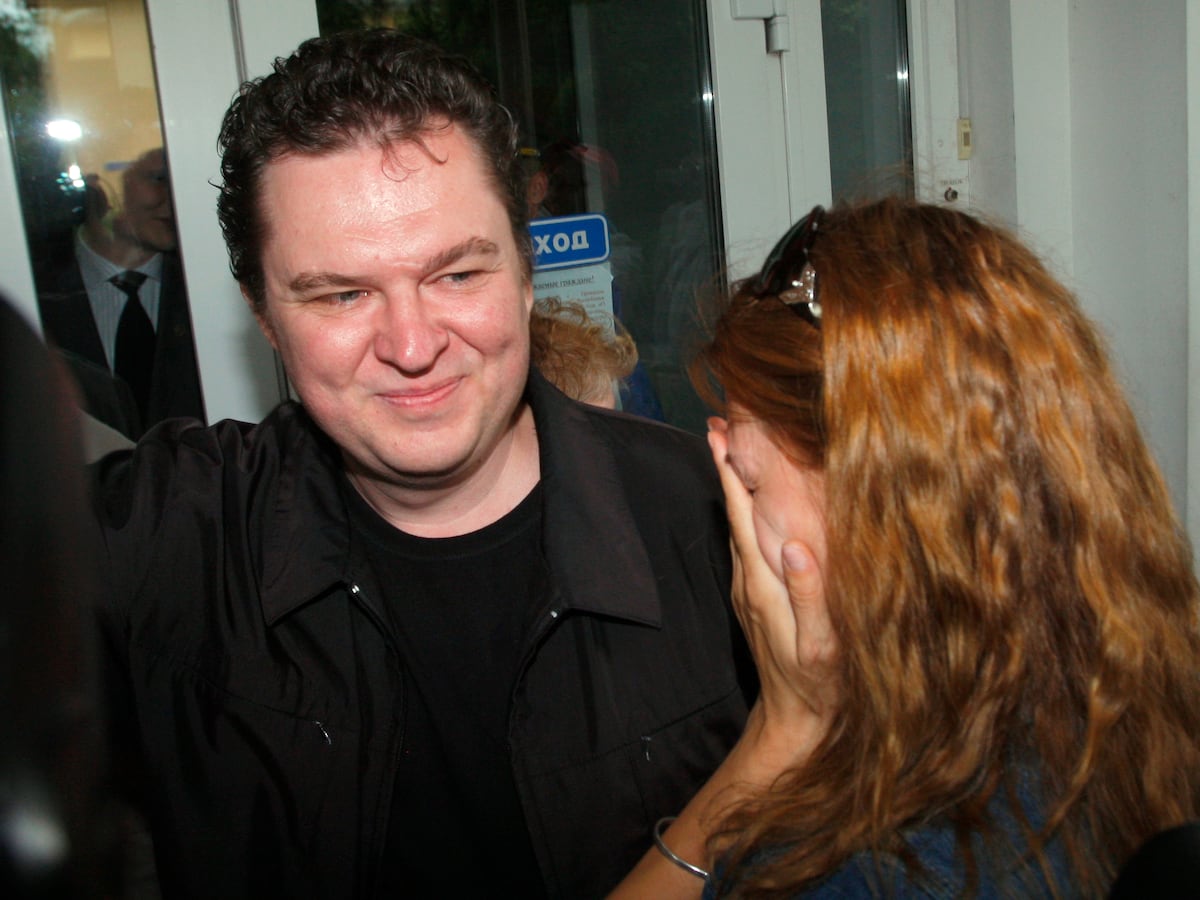
WARSAW, Poland (AP) — Prominent journalist Andrzej Poczobut has been released from jail in Belarus in a swap with Poland that saw a total of 10 people freed as the authoritarian leader of Belarus seeks improved relations with the West, officials in both countries said Tuesday.
Poczobut, a correspondent for the influential Polish newspaper Gazeta Wyborcza and a leading figure among Belarus’ Polish minority, was serving eight years in prison in a case condemned as politically motivated.
His 2021 arrest after covering pro-democracy rallies in Belarus drew widespread criticism. He later was awarded the Sakharov Prize, the European Union’s most prestigious human rights award.
Polish Foreign Minister Radek Sikorski called Poczobut a symbol of the fight for freedom in Belarus but also of the effectiveness of the Polish state in leaving no one behind.
Prime Minister Donald Tusk, who welcomed Poczobut at the border about midday Tuesday, posted on X that the journalist was “unwavering.” Poczobut’s first words to him were about his chances of returning home to Belarus, Tusk wrote, and said he replied: “Only you decide. You’re a free man now.”
Appearing at the border, Poczobut had noticeably lost weight, his face was gaunt and his head had been shaved. Bartosz Wieliski, the deputy editor in chief of Gazeta Wyborcza who met Poczobut there, said the journalist went straight to a hospital for a checkup. He added that Poczobut had lost over 19 kilograms (nearly 42 pounds) behind bars.
The swap was the latest in a series of U.S.-negotiated prisoner releases that have marked stronger relations with Minsk under U.S. President Donald Trump.
A Polish Foreign Ministry spokesman said three of the five prisoners released by Belarus came to Poland in exchange for three sent by Poland to Belarus, with a total of 10 involving other countries.
Included in the swap were Grzegorz Gawel, a Roman Catholic friar from the Carmelite order in Krakow, and a “Belarusian citizen who cooperated with our secret services,” Tusk said at a news conference, without identifying the latter.
Tusk described organizing the swap as a “complicated and sensational story,” saying a previous agreement to free Poczobut was derailed after Minsk backed out with less than 24 hours to go. Tuesday’s exchange was ultimately possible due to prisoners viewed as important by Belarus, Russia and Kazakhstan and held by Poland, he said.
Speaking of Poczobut’s release, Tusk said: “There were a few tough men present there and they all had tears in their eyes.”
Moldovan President Maia Sandu said two Moldovan citizens working for its intelligence services who were held in Russia had been released, although she did not identify them. She said they were exchanged for Russian citizen Nina Popova, who allegedly was “acting against” the state of Moldova, and Alexandru Balan, a former Moldovan intelligence official accused of treason in support of the Belarusian security services.
“For our country, it is a gain that cannot be measured by a simple mathematical equation,” Sandu said. “We brought home two citizens who work for the Republic of Moldova, giving up, in return, (two) prisoners who worked against the Republic of Moldova.”
The Russian state news agency Tass identified one of those released by Poland as Alexander Butyagin, a Russian national due to be extradited to Ukraine on allegations he conducted excavations involving artifacts at a site in Crimea that Kyiv considers part of its cultural heritage.
Belarus’ presidential press service said the negotiations had involved intelligence services from seven countries. It described some of the prisoners who returned to Minsk as having “carried out particularly important missions in the interests of ensuring the national security and defense capability of our country.”
Seeking better relations
In March, Belarus President Alexander Lukashenko ordered the release of 250 political prisoners as part of a deal with Washington that lifted some U.S. sanctions.
A close ally of Russia, Minsk has faced isolation for years. Lukashenko has ruled the nation of 9.5 million with an iron fist for more than three decades, and the country has been sanctioned repeatedly by Western countries — both for its crackdown on human rights and for allowing Moscow to use its territory in the 2022 full-scale invasion of Ukraine.
Writing on X, Trump’s special envoy for Belarus, John Coale, said three Poles and two Moldovans had been released as part of the swap. He thanked Poland, Moldova, and Romania for what he called “their invaluable support,” along with the willingness by Lukashenko “to pursue constructive engagement with the United States.”
Poczobut became a symbol of repression
Large portraits of Poczobut had appeared regularly at the Poland-Belarus border, a reminder of the large-scale political repression in Minsk and of tensions on the EU and NATO frontier.
Belarusian opposition leader Sviatlana Tsikhanouskaya told The Associated Press that Poczobut was a hero who had never betrayed his principles.
“After years of unjust detention and isolation, he can breathe freely,” she said, while calling for the release of the hundreds of political prisoners in Belarus.
Poczobut’s arrest followed his coverage of the pro-democracy rallies that engulfed Belarus in 2020 after the disputed presidential election that kept Lukashenko in office.
He decided to stay in Belarus despite the brutal crackdown that followed, resulting in over 65,000 arrests, thousands of police beatings and tens of thousands fleeing abroad.
Poczobut was sent to one of the country’s harshest maximum-security prisons to serve his sentence, despite ongoing worries for his health.
The Belarusian human rights group Viasna said he repeatedly was denied essential medications and refused contact with his wife and children. It also reported that he had been placed in solitary confinement for several months after refusing work that he was unable to perform due to his health.
“For Poland, Poczobut is a national hero. For Belarus, he’s a reminder that a state cannot be built on fear,” said Andżelika Borys, head of the Union of Poles in Belarus, who spent over a year in prison. “For Europe, he’s a witness to the fact that the struggle for freedom continues not in the pages of textbooks but in the prison cells of the 21st century.”
Viasna believes Belarus still holds 832 political prisoners. Its head, Nobel Peace laureate Ales Bialiatski, pledged to keep fighting until all were freed.
“Poczobut is a true hero, but let’s not forget that hundreds more political prisoners are still in prison awaiting release,” he told AP.
—-
Karmanau reported from Tallinn, Estonia, and Davies reported from Manchester, England.
—-
This version corrects the spelling of Carmelite friar’s name to Grzegorz Gawel, not Grzegorz Gawej.
Copyright 2026 The Associated Press. All rights reserved. This material may not be published, broadcast, rewritten or redistributed without permission.