

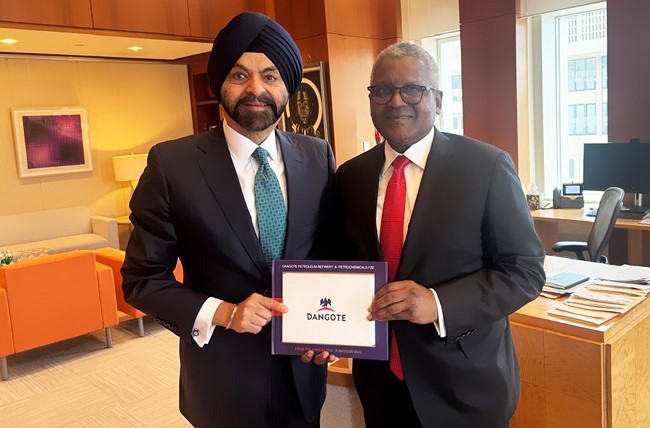
President/Chief Executive of Dangote Group, Aliko Dangote, held a series of high-level meetings with global financial leaders on the side-lines of the ongoing International Monetary Fund (IMF) and World Bank Spring Meetings in Washington, D.C., as part of efforts to deepen investment flows and strengthen partnerships in Nigeria’s energy and industrial sectors.
Dangote, Africa’s richest man, stated on Thursday that entrenched foreign interests had continued to undermine Africa’s industrial progress. He urged stronger regional integration and greater domestic investment to unlock the continent’s potential.
Dangote Industries Limited said it will showcase its Vision 2030, which focuses on driving innovation and Africa’s industrialisation, at the Nasarawa trade fair.
At the ongoing Spring Meetings, Dangote delivered the keynote address at the launch of World Bank Group’s flagship global initiative, Water Forward. It is a programme aimed at repositioning water systems from basic social utilities into catalysts for industrialisation, job creation, and large-scale economic growth across emerging and developing economies.
Dangote underscored the critical role of private sector investment and infrastructure in unlocking the economic value of water.
The event drew a distinguished audience, including heads of government, Secretary-General of the United Nations, leaders of European development institutions, and multilateral development partners.
Others included ministers of finance and economic planning from over 100 countries, central bank governors, global regulators, business executives, and donor agencies.
The audience at the Water Forward launch reflected the scale and urgency of the initiative.
In separate engagements, Dangote met with President of the World Bank Group, Ajay Banga; Managing Director of IMF, Kristalina Georgieva; and President/Chairman of Export-Import Bank of the United States, John Jovanovic.
According to a statement by Dangote Group, discussions at the session focused on private sector-led growth, macroeconomic reforms, and unlocking financing for large-scale infrastructure, trade expansion, and industrial development across Nigeria and Africa.
The engagements came at a time of renewed momentum in Nigeria’s energy sector.
The country became a net exporter of petrol in March 2026, for the first time in decades, as the Dangote Petroleum Refinery and Petrochemicals drove a shift from import dependence to local production.
Data from Kpler shows Nigeria exported about 44,000 barrels per day of petrol during the month, slightly exceeding imports and resulting in a net surplus of roughly 3,000 barrels per day.
The milestone, the statement said, aligned with Dangote Group’s newly unveiled long-term growth strategy, “Vision 2030: Supercharging Dangote Group for Long Term Success,” a two-phase expansion programme spanning 2025–2028 and 2028–2030.
Under the plan, the group aims to scale and optimise its existing operations while expanding capacity across key sectors. This includes increasing the capacity of the Dangote Petroleum Refinery from 650,000 barrels per day to 1.4 million bpd, as well as quadrupling fertiliser production from three million tonnes per annum to 12 million tonnes per annum, a move expected to position the company as the world’s largest producer of urea.
The strategy also outlines expansion across cement, rice, and broader food production, alongside new investments in infrastructure, such as ports and pipelines, gas, mining, data centres, and power, identified as critical to Africa’s industrial transformation and digital resilience.
Meanwhile, Dangote believed entrenched foreign interests had continued to undermine Africa’s industrial progress. He called for stronger regional integration and greater domestic investment to unlock the continent’s potential.
Dangote said while the promise of the African Continental Free Trade Area (AfCFTA) remained significant, its success hinged on the functionality of regional markets across the continent.
He spoke at an “Investing in Africa Forum,” held on the side-lines of the ongoing IMF/World Bank Spring Meetings in Washington.
He said, “The African free trade agreement will work, but it can only work when the regional markets work.
“The regional markets must work first because all the dots point to the regional markets and they are not working.
“You must also remember that there are a lot of international interests, and I’m sorry to say, they do not want to see Africa grow.
“We haven’t really had any refinery in Africa for donkey years, even the ones that they started in other countries, they have not been able to because there are so many interests not allowing that to happen.”
Dangote stressed that while foreign investment remained critical, it was ultimately driven by risk perception, one that African investors themselves must first address.
He explained, “Foreigners will invest. But foreigners are also very smart people. Any time you talk about risk, they want to look at it 10 times. So how can we de-risk?
“The only way is that we Africans must lead by investing in Africa and show that, yes, that risk is a perceived risk and not a real risk. That is because if I’m not investing in Africa, there is no way I can convince anybody outside the continent to come and invest. So, I must now show that this risk is passive.
“Of course, there is risk in China, Asia, everywhere. But you must know how to mitigate this risk.”
Dangote added, “For us in Africa, what I keep advising is, yes, in terms of cash, there might be some people who have more cash than me, but I advise you, don’t keep that money in a foreign bank, bring it back home, invest, the place is good.
“We have this problem of always looking for foreign investors. Foreign investors will never come because the foreign investor is smarter than us, so they won’t come. They can only come when they see that we are committed, we are serious, and we are investing our own money.
“When you invest your own money, then they will join you. So, once you start, other people will come in.”
Highlighting opportunities in value addition, Dangote cited Zambia’s copper exports as an example of missed industrial potential.
He stated, “In terms of business, a place like Zambia, they are busy exporting copper. We want to process that copper before it is exported. So, we want to just lead in some key critical areas, where now other Africans will look and say this thing is easy, and everybody will jump in, even if they don’t jump in, the other foreigners will now come in and be inspired.”
On his flagship refinery project, Dangote disclosed plans to significantly expand capacity, reinforcing his ambition to position Africa as a major player in global refining.
He said, “But going forward on the refinery, let me start on the refinery. We are taking the refinery to 1.4 million barrels per day. And that will make us the largest refinery in the world.”
Back home, Dangote Industries Limited promised to showcase its Vision 2030, an initiative to drive innovation and Africa’s industrialisation at an impending trade fair in Nasarawa State.
Dangote Group is the major sponsor of the Nasarawa Trade Fair and Exhibition (NASTFE), with the theme, “Unlocking Industrial Synergy: Deepening the Value Chain and Driving Inclusive Growth in Nasarawa State.”
A statement from the company’s spokesman, Anthony Chiejina, said other Strategic Business Units of the company would be participating at the annual event in the state capital, Lafia.
Chiejina stated that products to be featured at the fair would include those from the Group’s Strategic Business Units, such as Dangote Cement, Dangote Sugar, Dangote Salt and seasonings, Dangote SinoTruk, Dangote Packaging, and Dangote Fertiliser.
The statement quoted Regional Director/Senior Adviser to Dangote Group President, Fatima Wali-Abdurrahman, as saying that Nasarawa State was key to the Group’s overall investment in Africa.
Wali-Abdurrahman stated, “It is home to Dangote’s Nasarawa Sugar Company Limited (NSCL). The sugar project, when completed, will be one of the biggest sugar investments in Africa.”
Wali-Abdurrahman stated that the trade fair provided a valuable platform for the company to engage with key stakeholders and Nigerians interested in exploring business opportunities with the organisation.
She stated that a dedicated Help Desk will handle inquiries, enabling the company to effectively engage participants on the Dangote Group’s Strategic Business Units.
Speaking to newsmen in Lafia, Chairman and council members of Nigeria Association of Small-Scale Industrialists (NASSI), Nasarawa State Chapter, Nidan Sambo Manasseh, said the theme for this year’s trade fair aptly aligned with Dangote Group’s vision.
Manasseh stated, “We align strongly with the vision of Aliko Dangote, whose leadership continues to shape Nigeria’s economic future. His focus on industrialisation, local production, and value creation inspires our efforts to connect MSMEs to structured value chains.
“Through this partnership, we are building a bridge between grassroots businesses and large industries, driving inclusive growth.”
Speaking on Dangote Group’s Vision 2030, Manasseh said, “Our strategy is to align local enterprise development with large-scale industrial systems.”
Eromosele Abiodun and Nume Ekeghe , Peter Uzoho and Ibrahim Oyewale
Follow us on: