
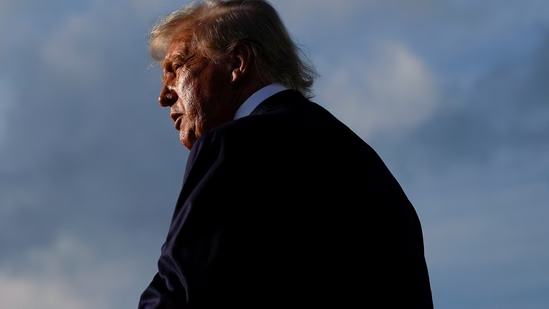
Donald Trump is crushing America’s farmers—yet they back him

TO SAM WATSON, farming has always been a gamble. Raised in southern Georgia, he learned the risks from a young age: farmers invest millions of dollars each year to plant a crop, and an unexpected drought or disease can wipe out profits in an instant. These days, though, he reckons the odds are worse than when his father was at it. Mr Watson, who moonlights as a Republican state senator, returned home from Atlanta just in time to put eggplant (aubergine), bell pepper and squash seeds in the ground. Soon dozens of workers will arrive for a harvest season that threatens to be his last. “We used to just pray for rain,” he says. “Now we’re praying on geopolitics, too.”

Donald Trump has waged various literal and metaphorical wars in his second term, but two have been especially bad for Americans: his trade war with the world and his actual war with Iran.

Donald Trump has waged various literal and metaphorical wars in his second term, but two have been especially bad for Americans: his trade war with the world and his actual war with Iran. Every American industry that makes things—from chemicals to cars to crops—suffered at least a little when Mr Trump slapped tariffs on other countries and some of them retaliated. Now, with the conflict in Iran unresolved and the Strait of Hormuz still blocked, those same businesses face higher costs. Few have suffered more than American farmers.

Even before Mr Trump took office, they were grappling with record costs. In just five years, land prices had risen by 6%, seeds by 18%, labour by 50% and interest expenses by 73%. When the president announced sweeping tariffs on “Liberation Day” last year, farmers’ already fragile budgets became harder to balance. As the price of steel and aluminium soared, so did the cost of machinery such as tractors and sprayers. In a February earnings call, John Deere, the world’s largest maker of farm equipment, said it absorbed $600m in tariff-related costs in 2025 and expected that to double this year. Dave Peters, a semi-retired corn farmer near Harlan, Iowa, reckons farmers now need four times as many acres to make the same profit. Watching his son and granddaughter ride a tractor across his field, he reflects on how much it takes to get a farm going: “It’s costing half a million just out the door.”

Countries targeted by Mr Trump did not take it lying down. China inflicted the most pain, cutting off American soyabean growers and sharply reducing its purchases of cotton. In the year to October exports of soyabeans to China fell from 5.9m tonnes to zero. Many farmers are fed up. “We need relief and we need it now: no new tariffs; available trade markets,” says Jason Lay, who grows soyabeans in Illinois. The Economist’s analysis suggests that agriculture was hit harder by retaliatory tariffs than any other American industry. Levies on exports raise their effective prices for overseas buyers, making American producers less competitive. By mid-2025, electronics and chemicals makers’ prices had risen by 2-3%. Agricultural prices were up by around 10%.

The price of Hormuz

The war in Iran is compounding the strain, just as the spring planting season begins. Unlike other industries, which can rely on cheap American natural gas and electricity, farmers depend on diesel fuel, the price of which has jumped by 40% since the end of February, to around $5.40 per gallon. For row-crop farmers burning tens of thousands of gallons a year, a $1 increase quickly eats into already thin margins. But the conflict has delivered a second, more damaging blow. A third of the world’s fertiliser supply passes through the Strait of Hormuz; its closure has sent prices soaring by as much as fuel. Preston Jimmerson, a cotton and pecan farmer in Georgia, reckons chemicals account for about 30% of his input costs. He plans to cut back by 15%, but fears this will hurt yields. “Taking the fertiliser away from a crop is like taking oxygen from a human,” he says.

Even if the growing season goes well, farmers face challenges on the other side of the ledger. Crop prices have barely budged in years. Come July Mr Watson expects to sell a box of yellow squash for the same price he did a decade ago.

For many, the numbers no longer add up. In 2025 farm bankruptcies rose by 46%. Lynn Paulson, a banker in Fargo, North Dakota, expects most of his farm borrowers to lose money this season. “They’re planning for profitability, but they’re fighting for survival,” he says. “Breaking even would be one heck of a win.” The strain sometimes also shows up in darker ways. The owner of Kerr Auction, a used-equipment house in Illinois, says in tough years more tractors come in from families of farmers who have taken their own lives. He now expects to see more.

Only about 6% of rural Americans work in the fields. Yet across much of the South and Midwest, farmers underpin a web of local businesses, from ethanol plants and meatpackers to banks, law firms and car dealerships. When farmers suffer, so does Main Street, says Bridgette Readel of AgMafia, a consultancy. In Moultrie, Georgia, where Mr Watson lives, the pain is already spreading. Three Crazy Bakers, a restaurant on the town square, is usually packed on Wednesday nights after church. But last week just four diners sat in a sea of empty tables. Breauna Coody, a 17-year-old waitress there, says her family no longer has spare cash for “normal teenage girl things” such as movie tickets and lip gloss. She works six nights a week and spends 75% of her pay on petrol. A recent Economist/YouGov poll suggests such troubles are now commonplace: 27% of rural respondents said it would be “impossible” to cover an unexpected $1,000 bill.

It would be easy to blame Mr Trump for the downturn. After all, he campaigned on promises to bring down prices and revive the heartland. But rural America does not. The president’s favourability rating is higher among rural voters than among any other group in our survey. Most still think he is doing a good job. In interview after interview with The Economist, farmers said they trust the administration—but that they need help to recoup the losses its foreign policy is causing them. The American Farm Bureau Federation, a trade group, is pushing the federal government to ease regulations on cheaper fuel and pass another stimulus package. This week the House of Representatives is expected to vote on the Farm Bill, which includes provisions that analysts reckon would help nearly double cash subsidies to farmers by 2027, to $41bn. “I don’t know one farmer who actually wants a handout,” says Jayden Jorgensen, a 25-year-old who works her father’s land in Iowa. “But if we don’t take them, then we’re behind everybody else.”

Economic hardship is nothing new in the countryside. But spend time in places where cattle graze under big skies and you find a kind of optimism that is rare in cities. Mr Watson is not sure it will make sense to plant another crop next year. Yet he is buying the cheapest boxes and pallets he can, downsizing his tractors and working “all hours of the night” to preserve his way of life. “I don’t know what drugs are like, but I imagine farming is similar,” he says, standing in his packing shed as workers prepare the machines for the vegetables he hopes will come. “It’s not good for you, but it gets in your blood and it’s addictive.”

🚨Watch The Full Video ➤