

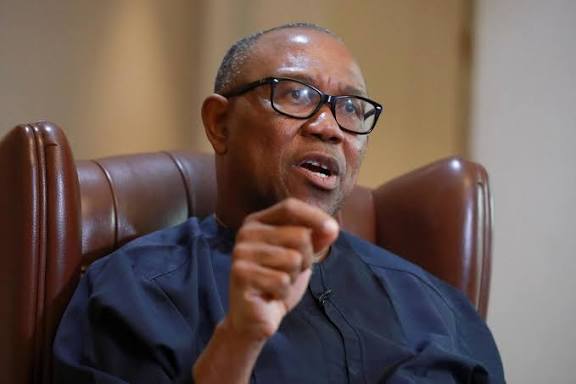
Former presidential candidate Peter Obi has raised alarm over what he described as a disturbing claim by the Economic and Financial Crimes Commission (EFCC) that a significant number of Nigerian university students are involved in internet fraud.
In a post shared on X (formerly Twitter), Obi said the revelation, attributed to EFCC Chairman Ola Olukoyede, points to a deeper crisis beyond crime, warning that the country may be facing a moral and systemic breakdown.
> “The worrisome statement by the Chairman of the Economic and Financial Crimes Commission (EFCC) that 6 out of every 10 Nigerian university students are involved in ‘419’ is deeply troubling and must not be taken lightly.”
According to him, Nigeria already has a relatively small higher education population, estimated at between two and 2.5 million students. If the EFCC’s claim holds true, Obi noted that roughly 1.4 million young Nigerians could be implicated in fraudulent activities.
> “If indeed about 60% of them, roughly 1.4 million young people, are involved in fraud, then we are not just facing a crime issue; we are confronting a serious moral and systemic failure.”
The former Anambra State governor questioned the societal influences shaping young Nigerians, asking what values they are being exposed to and who they look up to.
“The question we must ask ourselves is: what has brought us to this level? Who are the role models these students are looking up to? What values are they learning from society?”
He stressed that behaviour among youths often reflects what they see rewarded in society, warning that tolerance for misconduct among leaders sends the wrong signals.
“We must understand that young people become what they consistently see. When a system appears to reward wrongdoing, when integrity is not upheld, and when those in leadership are associated with allegations of forgery and dishonesty without consequence, it sends a dangerous message.”
Obi added that such a climate undermines the value of hard work and promotes a dangerous belief that success can be achieved by any means.
“It suggests that hard work does not matter, and that results, by any means, are acceptable. These points clearly point to a collapse of moral values.”
Citing the ancient Greek philosopher Socrates, Obi urged Nigerians to reflect deeply on the country’s direction.
“As Socrates rightly said, ‘An unexamined life is not worth living.’ Nigeria must now examine itself.”
He clarified that the issue should not be seen as a blanket condemnation of young people but rather as a reflection of leadership and societal standards.
“This is not about condemning our young people. It is about accepting that leadership sets the tone. If we do not demonstrate integrity at the top, we cannot expect it at the bottom.”
Obi called for urgent reforms aimed at restoring ethical standards and accountability across all levels of society. He emphasized the need to create an environment where honesty, discipline, and hard work are rewarded.
“We must urgently rebuild our value system, enforce accountability without bias, and create an environment where honesty, hard work, and discipline are rewarded. That is the only sustainable path to securing the future of our nation.”
He concluded his message with his signature optimism:
“A new Nigeria is POssible! -PO.”