

Russia and Iran are engaged in separate wars, but there is a growing perception that these conflicts are converging into a broader strategic battlefield stretching from Ukraine to the Middle East, pitting anti-Western powers against their adversaries across Eurasia.
As divisions between the United States and its Western allies grow more pronounced, Moscow and Tehran, both supported by China in key areas, are deepening cooperation across defence, trade, and other strategic sectors.
Recent high-level diplomacy has reinforced this trajectory.
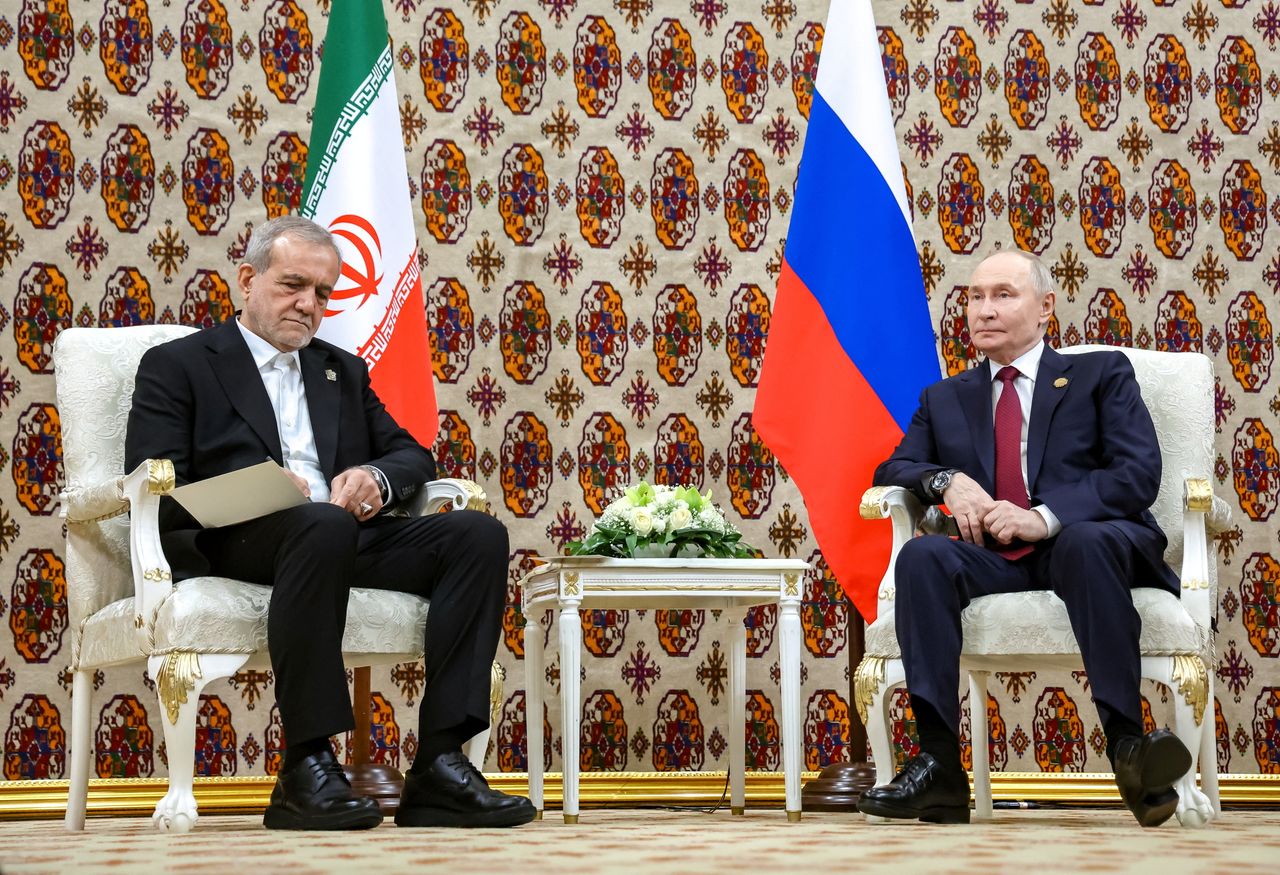
Iranian Foreign Minister Abbas Araghchi’s visit to Moscow, including talks with President Vladimir Putin, underscored the strengthening relationship as Tehran faces mounting tensions with the US and Israel.
“For our part, we will do everything that serves your interests and the interests of all the peoples of the region to ensure that peace is achieved as quickly as possible,” Putin said, praising what he described as the “courageous and heroic” defence of Iran’s sovereignty.
The deepening ties are also reflected in last year’s Iranian–Russian Treaty on Comprehensive Strategic Partnership, which spans defence, counterterrorism, energy, finance, and cultural cooperation, partly aimed at mitigating the impact of Western sanctions.
According to Oleg Ignatov, a senior Russia analyst at the International Crisis Group, the current conflict dynamics are accelerating this alignment.
“The war waged by Israel and the US against Iran has only strengthened these ties. If the assumption that Iran is now under the control of the Revolutionary Guard is correct, then cooperation between Russia and Iran will continue to grow,” he says.
IRGC-Russian army axis
Since the start of the war, a growing number of analysts have argued that the US-Israeli offesnive against Tehran has emboldened Iran’s Revolutionary Guard, expanding their influence across state institutions.
Some assessments suggest their reach now extends even to Supreme Leader Mojtaba Khamenei, who has not appeared in public since assuming power following the killing of his father, Ali Khamenei, on February 28.
Building on the view that the IRGC has become the dominant force in Tehran, Oleg Ignatov says that military cooperation between Iran and Russia is likely to deepen if the Guard continue to consolidate power across the state.
While the exact nature of ties between the IRGC and the Russian military “is not known for certain,” Ignatov notes that it is “known” that the two sides have exchanged battlefield experience from Ukraine to the Gulf.
Related
“Close ties exist at the level of the Guard Corps, the Russian intelligence services and the military,” he says.
During the US-Israel war, reports suggested that Iran’s precise strikes on US bases in the Gulf may have been enabled by intelligence sharing with Russia. In turn, Iran has reportedly supplied Russia with long-range drone technology during the Ukraine war.
Ignatov also cites unconfirmed reports that Iran supplied missiles to Russia in 2022, as well as claims that Moscow assisted Tehran in suppressing protests before the recent US-Israel strikes.
“In Russia, only a small group of people are aware of these relations,” he tells TRT World.
“We can assume that Iran and Russia are cooperating on a wide range of issues—technology sharing, including military technology, possibly some cooperation regarding the Internet, the sharing of combat experience and intelligence.”
Overall, Ignatov argues that the greater Iran’s resilience in its conflict with the US and Israel, the more support it is likely to receive from Russia.
However, he cautions that this has not yet developed into a formal military alliance, noting that the two countries have no treaty obligating mutual defence.
Despite speculation about closer alignment following the 12-day war in June, experts also highlight Russia’s longstanding ties with Israel, which has a significant Russian-speaking population, as a limiting factor.
“It is difficult to assess how far Russia is willing to go with Tehran, particularly if backing Iran risks damaging its relationship with Israel,” Fatemeh Karimkhan, a Tehran-based Iranian journalist, tells TRT World.
“That said, the war is likely to push Russia and Iran closer together,” she adds.