

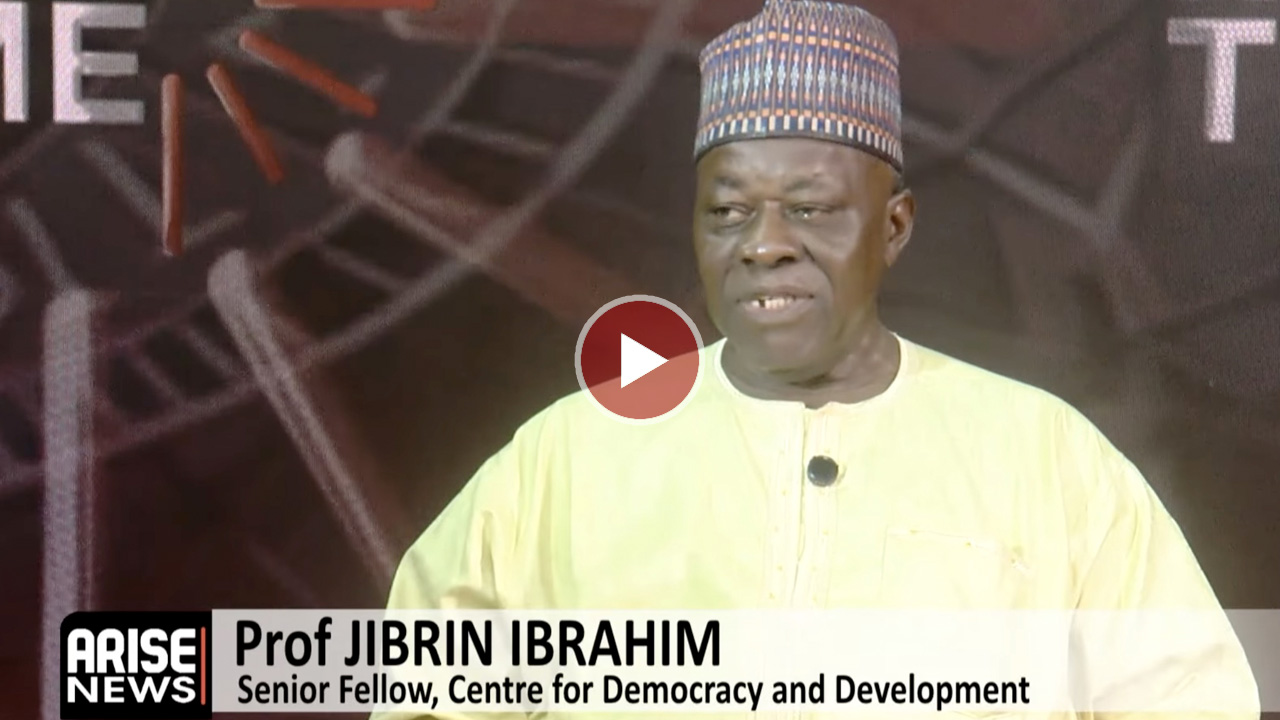
Political Scientist, Development Expert, Senior Fellow at the Center for Democracy and Development, and Chair of the editorial board of Premium Times Newspaper, Professor Jibrin Ibrahim has raised concerns about Nigeria’s democratic trajectory, noting that opposition parties are being systematically weakened and that, in his view, recent government actions are contributing to the erosion of democratic norms and public trust in the political process.
He said this in an interview with ARISE NEWS on Monday.
“When I see the way in which all opposition parties are being messed up deliberately through the action of government-sponsored agents, clearly the message that’s written on all walls in this country is that that dangerous moment is approaching,” he warned.
Speaking on the state of insecurity in Nigeria, Prof Ibrahim argues that current intelligence warnings are not translating into effective security outcomes. He notes that the shift from attackers hiding in remote areas to directly targeting military formations and senior officers reflects, in his view, a worsening situation rather than improved preparedness.
“The issue is that what we are hearing and what we are seeing is that the intelligence emerging is not enough to guide our security forces to achieve success. If we are moving from a position in which these terrorists were hiding from the government, looking for remote places, and now they are attacking military formations, picking up colonels and generals and assassinating them, then you cannot make the argument that intelligence is producing useful results,” he argued.
Reacting to reports about the US State Department’s decision to draw down staff in Abuja, Prof Ibrahim says it suggests that the situation on the ground is more serious than publicly acknowledged. He argues that such a move reflects concern about escalating insecurity and raises questions about how foreign security cooperation is being managed and communicated to Nigerians.
“The point I was making there is that it appears as if the Americans were rattled. They thought they were coming for a dinner party and they see it’s real war; people are being killed. And therefore, they needed to take the situation more seriously, withdraw, and rethink about whether they can continue and, if so, how. And that’s troubling for a country that prides itself as the strongest in the world, that announced to the entire world it was coming guns-a-blazing to kill all the terrorists and restore order, and at the end of the day, they seem to be frightened by the seriousness of the situation they met on the ground.”
He further criticised what he describes as a lack of transparency from government, stating that citizens are not adequately informed about agreements with foreign allies or the nature of their involvement.
“Of course, on these issues, we never really know all the details. Nobody has explained to Nigerians what the accord between the Nigerian government and the American government is, so I don’t even know that. And we don’t know how they are deploying and what they have been doing since they came here. There was one big-bang effect, the Christmas missiles that hit Sokoto State, and that was really all we know about what they’ve done since they came.
“So I’m worried also that we don’t have that information from our own government—that we are inviting a friendly ally to do A, B, C in the context in which we find ourselves. That’s the normal thing: to explain to your people what these foreign forces you are inviting are here to do and whether it was—it is considered safe to invite them to do that thing. But we are now in a type of government which believes that it doesn’t need to tell citizens anything and it just does what it wants, and then everybody has to simply tolerate it. I think it’s very unfortunate,” he lamented.
Speaking on Nigeria’s political environment, Prof Ibrahim argues that the credibility of democratic governance depends on adherence to agreed rules of political competition.
“When you are talking about system maintenance, the most important thing is that there are rules of the game and the government, in particular, accepts and follows the rules of the game.”
Adding, he warned that any attempt to prevent opposition participation in elections undermines legitimacy and increases the risk of systemic instability, especially in a context already burdened by insecurity, poverty, and weakening rule of law.
“My point about the politics of this administration is that it is aimed at preventing the opposition from contesting the presidential election. That is a fundamental breach of the rules of the game of democratic politics. And any government that does that is raising the risk of system collapse. And that is dangerous; that’s in nobody’s interest. And going through an election where you have used forces under your control to stop the opposition from contesting means you come out of that election with zero legitimacy. In a context of very serious security situations, breakdown of rules and rule of law, and above all, a security situation that mixes with the highest level of poverty and misery in the history of this country produces a dangerous cocktail that government should be aware of trying to avoid rather than running towards it,” he said.
Prof Ibrahim acknowledged that Nigeria’s security and economic challenges are cumulative, spanning several administrations. However, he noted that the current situation is different, pointing to what he describes as efforts to prevent opposition coalitions from freely contesting elections, which he said could signal a deeper democratic decline.
“I would completely agree with that point, that this is a cumulative problem that has grown over many governments. In fact, some of them since the first Obasanjo regime. So I accept that. But what is at play now, and where it’s clearly this government that is solely at fault, is that the preceding government of Buhari set up a united opposition alliance, contested, and won elections. The sitting government at that time did not stop them.
“We can see clear and open evidence that the sitting government is trying to stop a similar opposition coalition. That’s a huge difference, and that is the type of difference that could create a qualitative deterioration of the system in terms of system collapse,” he maintained.
Commenting on concerns about key democratic institutions, Prof Ibrahim says INEC and judiciary are, in his view, showing signs of partisanship that undermine their neutrality.
“I think the chairman of INEC is relatively new; he’s just been appointed. But in a very short time, we’ve seen numerous evidence of partisanship. His intervention in terms of targeting the main opposition party without a legal basis that most senior lawyers find acceptable in this country indicates that what we have is not a neutral arbiter of election, but a partisan who is coming to do the job of his master.
“And when evidence emerged that he did have partisan opinion in the last elections and had committed himself on Twitter in terms of showing that partisanship openly, then clearly the basis on which that appointment takes place—which is that it must be somebody who is non-partisan in his beliefs and would be non-partisan in his action—collapsed. And that, I think, is extremely disturbing.
“The other issue is the judiciary, and I think there, all of us are witnesses of how over the last few years the judiciary has started taking all sorts of actions that were blatantly against their own rules, that are against our constitution and our laws, and that do not make legal sense.
“And what is on the table now is that the judiciary—a significant component of the judiciary—has been compromised and are therefore taking action that have no basis in law and no basis in constitutionalism. These two challenges that we face at this moment pose for me, and I think for most Nigerians, serious concern on the health of our democracy,” Prof Ibrahim pointed out.
Prof Ibrahim says the government should prioritise allowing the opposition to operate freely within the rules of democratic competition rather than focusing on restricting them.
“I think the first thing is the government should leave the opposition alone. The rules of the game are that elections are contested by different people, different parties, different candidates, and each one tries to win, not to try to stop the other one from even contesting in the electoral space. They have shown themselves to be so desperate about stopping the opposition, which is a statement to Nigerians they don’t believe they can win the election. And I think in their own interest, they should at least pretend they believe they can win the election. And if they are so frightened of the opposition and are so desperate in the moves they are making against them, they are showing themselves as a party that is incapable of winning the election,” he said.
Adding, he said: “If I were the government’s political adviser, I would strongly advise them to be bold, to put all they can to sell their own candidate rather than to focus all their attention and all their energy on stopping the opposition. They shouldn’t look as if they are so frightened that they don’t feel they can get into that contest.”
Favour Odima
Follow us on: