

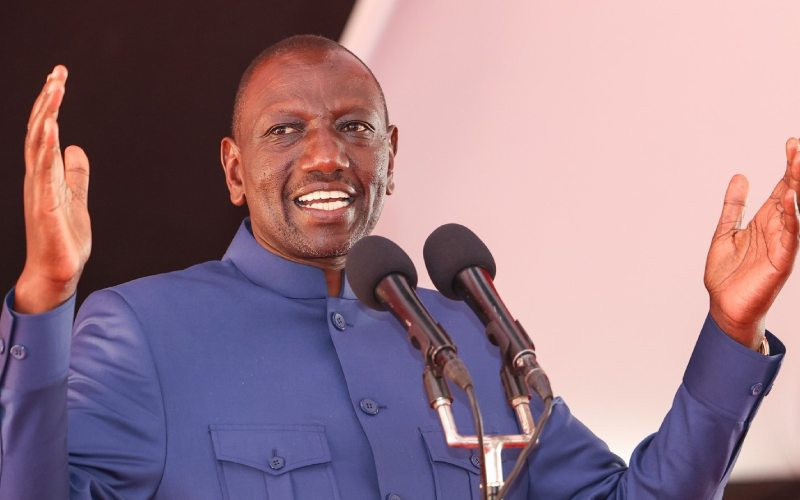
Kenyan President William Ruto has sparked widespread backlash on social media after suggesting that Nigerians speaking English are difficult to understand and may require translation.
Addressing Kenyans living in Italy on Monday, Ruto praised Kenya’s education system and contrasted it with what he described as challenges in understanding Nigerian speech.
He said:
“If you listen to a Nigerian speaking, you don’t know what they are saying – you need a translator.”
He added that Kenya’s education system produced strong English proficiency, insisting that Kenyans spoke “some of the best English in the world.”
“Our education is good. Our English is good. We speak some of the best English in the world.”
Ruto made the remarks while speaking to the Kenyan diaspora in Italy, where he was highlighting national capacity and human capital development.
He further said:
“We have some of the best human capital anywhere in the world. We just need to sharpen it with more training.”
The comments immediately triggered outrage across social media platforms, with many users accusing the Kenyan leader of being dismissive toward Nigerians and reinforcing divisive comparisons between African countries.
Critics argued that English is shaped differently across African nations due to indigenous linguistic influences, noting that Nigerian English reflects the country’s vast linguistic diversity.
Nigeria, with hundreds of indigenous languages, has developed a distinct form of spoken English that incorporates local rhythms, pronunciation patterns, and expressions.
Social media reactions described Ruto’s remarks as insensitive, with users arguing that language variation should not be used as a measure of intelligence or national value.
Others referenced Nigeria’s cultural and literary contributions, pointing to its global recognition in arts and literature as evidence of its linguistic depth and influence.
Some commentators urged the Kenyan president to prioritise domestic economic and social issues rather than making comparisons perceived as unnecessary or provocative.
Defenders of Ruto, however, said the remarks were taken out of context and were meant in a light-hearted tone during his engagement with the diaspora.
Erizia Rubyjeana
Follow us on: