

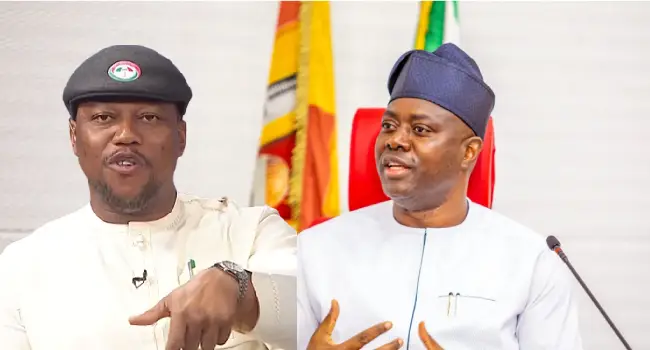
The National Publicity Secretary of the Kabiru Turaki-led Peoples Democratic Party (PDP), Ini Ememobong, has defended remarks by Oyo State Governor, Seyi Makinde, referencing the historical “Operation Wetie,” insisting the comment was intended as a cautionary reminder rather than a threat.
Appearing as a guest on Channels Television’s The Morning Brief programme, Emenobong said the governor’s statement had been widely misinterpreted by critics.
Makinde had come under fire from the ruling All Progressives Congress (APC) following comments made during a summit of opposition political party leaders in Ibadan on Saturday, where he warned against the dangers of a one-party state.
In his address, the governor said, “For those who are carrying on as if there is no tomorrow, they should remember that ‘Operation Wetie’ started from here. This is the same Wild Wild West.”
]]>
The remark drew criticism from the APC, with its National Publicity Secretary, Felix Morka, describing it as “reckless” and a potential threat to national peace.
However, Ememobong dismissed such interpretations, arguing that Makinde’s reference was rooted in history and aimed at preventing a repeat of past political crises.
“Everyone should commend Governor Seyi Makinde for reminding us of the circumstances and the consequences. What is the essence of history if it does not teach? Those who neglect history are doomed by it,” he said.
READ ALSO: [2027] Ibadan Summit Not Targeted At One Man, Says Makinde
“Operation Wetie” refers to the wave of political violence that engulfed Nigeria’s Western Region, particularly Ibadan, following the disputed 1965 elections, an episode widely regarded as a precursor to the collapse of the First Republic.
]]>
According to Ememobong, the governor’s comments were meant to highlight similarities between past and present political tensions, urging stakeholders to act responsibly.
“It is not the re-enactment of ‘Operation Wetie’. It is a reminder, a cautionary sign. That is why you have guardrails and caution signs of speed bumps ahead,” he said.
Addressing concerns that the remark suggested a “do-or-die” approach to politics, Ememobong insisted that the focus of the opposition was wider than electoral victory.
He further accused the ruling party of actions capable of undermining democratic institutions, including weakening opposition structures and creating political tensions across the country.
]]>
Ememobong also revealed that recent opposition engagements, including the Ibadan summit, were aimed at preventing a one-party system and safeguarding democratic competition ahead of the 2027 general elections.
He noted that discussions among opposition leaders could lead to a unified front, potentially featuring a single presidential candidate to challenge the ruling party.