

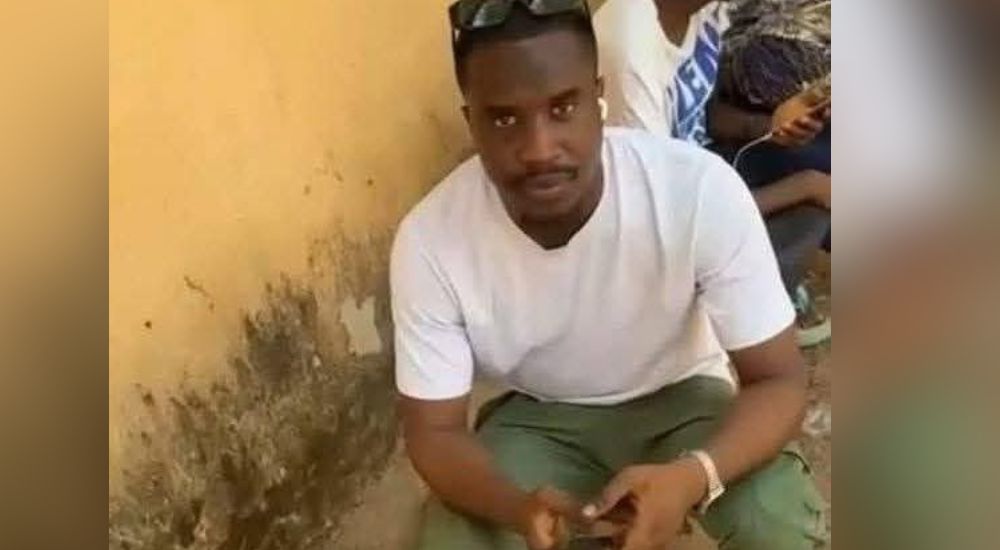
Grief settled heavily over the quiet compound in Shagari Quarters, Dei Dei, Abuja, where a family now struggles to make sense of a loss that came without warning, without explanation, and, by their account, without justification.
“My golden boy is dead. If he was not safe in his home, where else can he be safe?” These were the repeated words of the mother of late Abdulsamad Jamiu, Mrs. Habiba Abubakar, to TOPHEADLINES during a visit.
In the early hours of Saturday, April 25, 2026, bullets fired by soldiers of the Nigerian Army cut through the stillness of the night and ended the life of a 24-year-old who, until that moment, lay asleep in his room.
Jamiu, fondly called the “golden boy” by his family, served as a National Youth Service Corps (NYSC) member in Abuja and had looked forward to completing the programme in May 2026.
His journey, began in Okene, Kogi State, where he was born on September 29, 2001. He later graduated from the Federal University of Technology, Minna in 2025 with a Second Class Upper degree in Civil Engineering.
Inside the family home, his absence now echoes through carefully arranged spaces that once reflected routine, warmth, and shared aspirations.
TOPHEADLINES observed that the compound opens into a short walkway leading to a white duplex with a balcony lined by a silver railing. The double doors open into a main sitting room, which connects to a dining area and kitchen.
A passage to the right leads to three rooms—Jamiu’s room sits slightly apart on the left. Upstairs, a staircase leads to a mini parlour, more rooms, and a balcony converted into a modest fashion workspace, which the jamiu had shared with his mother.
It was in this home that violence arrived.
Family members said Jamiu had planned to enrol in the Army short service after completing his NYSC. That ambition ended abruptly when soldiers, from the Guards Brigade, made their way into the compound around 2:00 a.m. and opened fire during what the Army later described as a “crossfire between the troops and armed robbers in the estate.”
His mother rejects that account. “Even if there was a robbery incident, which never occurred, what was the army doing inside my house at 2:00 am. They jumped my fence, went through the emergency door at the back because the main entrance was locked, and headed straight to his,” she said.
She continued, her voice breaking under the weight of disbelief, “The army gained illegal access to my home and killed my golden boy. How can a crossfire occur inside my son’s room? You shot him while he was unarmed, wearing shorts. What was his offence? He is just 24.
“Who will ask me what the problem is or what I wanted? Jamiu was, he made me a mother, he is supposed to bury me, but I buried him, because some people believe they can take his life. If my son were not safe in his home, where else could he have sought sanctuary?”
Mourners filled the house, their quiet consolations blending with the low hum of grief. In another corner, the father received visitors, his composure strained by the weight of unfolding realities.
Physical evidence within the home tells a stark story. Jamiu’s bedroom door bears two bullet holes—one just above the doorknob, another closer to the frame. Inside, a bullet mark punctures the wall.
Dried blood stains the ceiling, walls, and a table nearby. No doors were broken. No signs of forced struggle appear beyond the gunfire itself.
Outside, part of the barbed wire fencing on one side of the compound had collapsed, while the adjoining fence—shared with a neighbour—remained intact.
“I wasn’t in Abuja when my son was killed,” Engr. Sani Jimoh, Jamiu’s father, told TOPHEADLINES.
He had travelled to Okene with his wife following the death of his own mother just two days earlier. They left their children at home, trusting their eldest son to look after the family.
“I’m his father. And this is my residence. It’s not a rented apartment. So we built this house, and this is where we live.
“On that day, I was away with my wife. I lost my mom. I had to travel together with my wife. Then we believed Samad was old enough to take care of his siblings at home. And we left them at home to travel and went to Okene for the burial.”
What followed came through a frantic phone call. “That very day this happened was supposed to be the three-day prayer for my late mom. And a call came in from my daughter Farida. She said, ” Daddy, daddy, daddy, the worst has happened.
“I said, what happened? She couldn’t control herself. She ended the call. Then I called her back and said, please calm down and talk to me since you called.”
“So she said, they have killed Samad. I said, who? She said, soldier.”
At first, he refused to believe it. He continues, “I said, okay, I will try to call the neighbour now. I don’t believe he is dead. I will try to call the neighbour, at least they will rush him to the hospital. But she repeated, ” Daddy, I said he is dead. They blew his head off.”
Still searching for clarity, he spoke directly with one of the soldiers after asking his daughter whether she still had company.
“She handed over the phone to one of the soldiers. I said, please can you tell me what happened? He said, they were pursuing armed robbers, suddenly they didn’t see the person they were again.”
“When they looked around, they saw a barbed wire that dropped down inside my compound and suspected the robbers had jumped through that fence. So, they also jumped through the fence” Jimoh noted
But the explanation only deepened the father’s questions. “I then asked him, how did you get into my house? This soldier said, Oga, don’t bother about it, calm down. I said, ” You killed my son, and you’re asking me to calm down? He said, ” Calm down.
“Then they saw a door and they were trying to open that door, but somebody was there forcing the door not to open… And I asked him, then the next thing you could do was to shoot him in the head.”
The soldier’s response remained unchanged, “Oga, calm down, calm down” Jimoh told TOPHEADLINES.
Jimoh insisted the soldiers stay until the neighbours arrived, which they did, but moments later reality set in.
“I asked my neighbour to please check my son, if he could rush him to the hospital. Then my neighbour confirmed to me that my son is dead.”
Unable to break the news to his hypertensive wife, he told her only that their son had been arrested. They began the journey back to Abuja in the early hours of the morning.
Between 3:00a.m. and 7:15 a.m., events continued to unfold at the house.
TOPHEADLINES gathered that the soldiers instructed Jamiu’s siblings to step outside, called for reinforcement, and directed vigilantes to clean the scene.
Farida, Jamiu’s sister, recalled the moment she encountered the soldiers in TOPHEADLINES.
“The gunshot woke me up, coming down to the sitting room. Torchlights were flashed to me, and immediately I started screaming please do not kill me, as I didn’t know who they were, and one of the soldiers shouted, stop shouting, it is too early. Who are you? He asked, and I responded, ‘This is my father’s house.’
“Then I asked, please, where is my brother, at first they stopped me, but I forced my way through, and that was how I saw my brother on the floor, in a pool of his blood and his brains scattered on the ground. Immediately, I called my dad.”
She described what followed, “After the neighbour had confirmed that my brother was dead to my dad. The soldiers told me to go outside with my siblings. Minutes later, the vigilantes arrived, the soldiers called for reinforcement, and I counted an additional ten soldiers. and some began to take pictures of themselves and our house.”
Faridah noted that the police arrived, took the body, and left while the soldiers instructed the vigilantes to clean his blood. She added that the soldiers locked the house after the cleanup, handed the keys to the vigilantes and instructed the gate to remain locked pending the parents’ return.
She added, “Our neighbours took us in because of the trauma, till my parents arrived from Kogi.”
Efforts by TOPHEADLINES to speak with the neighbour proved unsuccessful, as a visit to the residence did not yield any response, and calls made were not answered as of the time of filing this report.
When Jimoh finally arrived, the official explanation he encountered did little to ease his doubts.
He said, “When I came, I called my neighbour and asked what had happened. They said the police had taken the body to Kubwa General Hospital.