

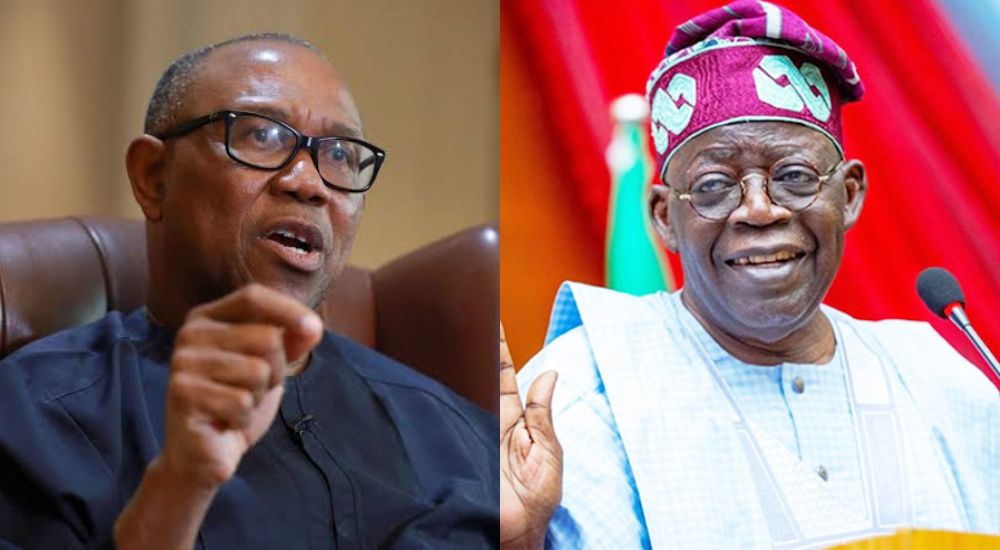
Former Labour Party presidential candidate, Peter Obi, has slammed President Bola Tinubu’s recent justification for external loans. He described the nation’s current borrowing spree as a “killer cancer” rather than a mere ailment.
Obi’s reaction followed Tinubu’s recent comment that “If we have to borrow, we borrow. Borrowing is not leprosy, we just have to work hard to be able to pay for it.”
Tinubu stated this while receiving Plateau State leaders at the State House, Abuja, on Tuesday.
Obi, in a Facebook post on Thursday, accused President Tinubu of downplaying the severity of the country’s economic situation.
“Mr. President, borrowing is not only a leprosy, but a killer cancer when it is borrowed for consumption and not production as it is in Nigeria today,” Obi stated.
“Borrowing for consumption slowly eats away at the health, reputation, and autonomy of a nation.”
He said the primary issue facing the country is “debt without productivity.”
According to him, debt should translate into measurable economic value.
“One of the major ‘leprosy’ afflicting Nigeria today is not just debt, but debt without productivity. Debt that is not tied to measurable economic value. Debt that does not translate into jobs, growth, or improved living standards for the Nigerian people,” Obi said.
The African Democratic Congress chieftain also challenged the legality of the government’s borrowing, citing the Fiscal Responsibility Act of 2007.
He noted that the Act requires government agencies to specify the purpose of loans and provide a cost-benefit analysis.
“Most of the borrowings by this government do not satisfy the requirements of law or the requirements of economic common sense,” Obi claimed.
“The humongous borrowing so far does not show how the projects for the loans enhance the productive capacity of the nation and the welfare of Nigerian citizens.”
He warned that Nigeria’s high debt-servicing ratio creates a state of “double jeopardy.”
“These loans are also dangerous because they burden the capacity of the Nigerian state to improve the economy in the future, as we have one of the world’s highest debt servicing ratios.
“What matters is not debt-GDP as much as debt-debt servicing ratio because the latter constrains our capacity to finance the sectors that drive human development and economic growth
“If the money is wrongly spent as we do in Nigeria currently, it becomes double jeopardy because you are using current revenue to service debts that did not add to revenue or improve capacity for more production in the future.
“A responsible government does not merely defend borrowing; it explains it, justifies it, and most importantly, ensures it works for the people,” he added.
On April 15, the Debt Management Office (DMO) revealed that Nigeria’s total public debt surged to N159.27tn by the end of the fourth quarter of 2025. It jumped from N97.34 TN that was recorded in late 2023.
The House of Representatives recently approved an additional $516.3m external loan for the Sokoto–Badagry Superhighway. This followed Tinubu’s request in March for a $6bn external borrowing plan.