

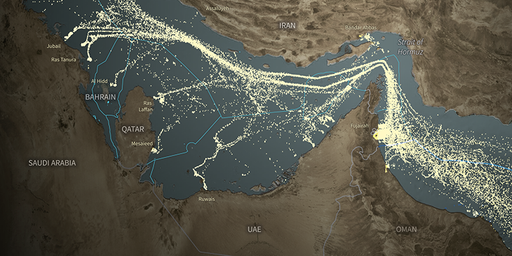
Iran’s foreign minister said the Strait of Hormuz was open for all commercial vessels for the remainder of the US-brokered ceasefire between Israel and Iran-backed Hezbollah, prompting a sharp fall in the price of oil.
A senior Iranian official said all vessels, except for naval ships, would be able to sail through the strait, but their plans needed to be coordinated with Iran’s Revolutionary Guards, and ships transiting would be restricted to lanes Iran deemed safe.
The US-Israeli war with Iran, which began on February 28, has killed thousands of people, destabilised the Middle East and rocked global energy markets by effectively closing the strait.
Here are details on the strait and its importance.
What is the Strait of Hormuz?
Lying between Oman and Iran and linking the Gulf north of it with the Gulf of Oman to the south and the Arabian Sea beyond, the strait is 21 miles (33 km) wide at its narrowest point, with a shipping lane just 2 miles (3 km) wide in either direction.
Perhaps the world’s most important energy shipping channel, the waterway is about 104 miles (167 km) long.
Following through on an old threat, Tehran effectively closed the strait after US-Israeli strikes on Iran began on February 28. During the standoff over the strait, Iran threatened to charge fees on ships passing through.
No such unilateral move to demand fees to traverse a strait has been made in modern history, shipping industry officials said, while US President Donald Trump has said free traffic of oil through the strait must be part of any peace deal.
Why it matters for oil, gas, jet fuel and fertilisers
About a fifth of the world’s oil and liquefied natural gas (LNG) supplies normally pass through the strait, which is the only sea exit for the fuels from key exporting countries.
OPEC members Saudi Arabia, Iran, the UAE, Kuwait and Iraq export most of their crude via the waterway.
Qatar, among the world’s biggest liquefied natural gas exporters, sends almost all of its LNG through the strait, while analytics firm Kpler estimates about 33% of the world’s fertilisers, including sulphur and ammonia, pass via the strait.
Traffic has dropped by 97% since the US-Israeli war against Iran began on February 28, United Nations data shows.
Related
Long history of tensions over the strait
When a commander in Iran’s Islamic Revolutionary Guard Corps warned in 2011 that cutting off the strait would be “easier than drinking a glass of water”, the threat to the strait had already been made many times before.
During the 1980 to 1988 Iran-Iraq War, the two sides sought to disrupt each other’s exports in what was called the Tanker War.
And in January 2012, Iran threatened to block the strait in retaliation for US and European sanctions. In May 2019, four vessels – including two Saudi oil tankers – were attacked off the UAE coast, outside the Strait of Hormuz.
Three vessels, two in 2023 and one in 2024, were seized by Iran near or in the strait. Some of the seizures followed US seizures of tankers related to Iran.