

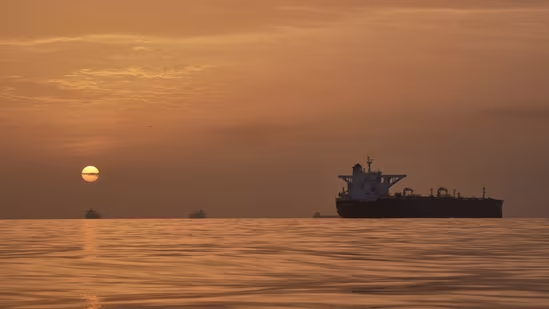
Iran has, for decades, issued threats of closing the Strait of Hormuz over conflicts with countries in the Middle East and sanctions like those imposed by the US. The long history of tensions dates back to Iran’s 1980-88 war with Iraq.
Iran’s closure threats have never come to fruition until the February 28 joint US-Israeli strikes against the Islamic Republic prompted it to actually ‘shut’ the strategic waterway.
Today, a US naval blockade amid the already-imposed closure by Tehran in the Strait of Hormuz raises global concerns. On one hand, the Trump administration claims its blockade is effective, while on the other, Iran says its control remains intact.
ALSO READ | ‘Violating vessel will be targeted’: Iran’s big warning on approaching Strait of Hormuz
Yet, data from shipping analytics firm Kpler shows that 20 tankers transited the Strait of Hormuz on Saturday alone. Meanwhile, nine ships have so far reportedly complied with orders to turn around, including a Chinese-owned vessel called the Rich Starry.
The Chinese-owned tanker failed to leave the Strait on the first day of the US naval blockade. Owned by Shanghai Xuanrun Shipping Co, the Rich Starry was sanctioned by the US for dealing with Iran.
In the long run, Iran will be in a much better position in exercising authority over the Strait of Hormuz, not the United States.
Iran realises its most powerful weapon
It is only now that the world has come to realise that the Strait of Hormuz is Iran’s biggest weapon. While it has threatened to close the oil chokepoint several times in the past, it never actually took such a decision.
However, the current war with the US and Israel has made the Strait an existential factor for Iran.
ALSO READ | ‘No port in Gulf will be safe’: Iran issues fresh warning over US Hormuz blockade plan
The US and Israel are aiming to obliterate Iran’s nuclear capabilities, which Tehran has said it does not wish to achieve. But nobody saw how this conflict ended up giving Iran one of its most powerful new tools – the Strait of Hormuz.
Iran has repeatedly asserted that it will not relinquish its control over the critical waterway, through which nearly one-fifth of global oil supply transits. So much so that Tehran included its sovereignty over the Strait among the demands in the peace talks with the US.
If the Islamic Republic achieves its goals and retains long-term control over the Strait, it stands to benefit economically and in terms of its stature on the global stage.
From a financial standpoint, Iran’s move to impose a tollbooth system in the Strait of Hormuz would yield billions of dollars if its authority persists.
Reports from earlier this month suggested that Iran will charge a toll of $1 per barrel of oil and demand the sum in cryptocurrency from shipping companies to let their oil tankers transit the Strait.
Spokesperson for Iran’s Oil, Gas and Petrochemical Products Exporters’ Union, Hamid Hosseini, told the Financial Times that Tehran’s move came amid its need to monitor what goes in and out of the Strait to ensure the two-week ceasefire isn’t used for transferring weapons.
Several reports, including that from Iran International, suggested that Iran is charging up to $2 million per vessel. Considering the normal everyday traffic in the Strait is around 150 ships, imagine the revenue Iran could generate in a month.
The Strait is also a security guarantee for Iran — a reality that became evident when its closure disrupted global energy supplies and sparked panic across the world. Tehran has ensured to show that any future military action against it would bring severe economic repercussions.
Geopolitical leverage is another power in Iran’s corner due to the Strait of Hormuz. This is because Tehran’s control over the waterway enables it to bargain with energy-dependent states that import over 80 per cent of their oil.
For example, India imports over 85 per cent of its crude oil, the majority of which is from the Gulf region. China is also a massive importer, buying over 80 per cent of Iranian oil.
Iran’s warnings over Hormuz
Iran has issued several warnings regarding the sovereignty and territorial integrity of the Strait of Hormuz. Last week, the spokesperson for the Khatam al-Anbiya Central Headquarters said that maritime security in the region must be “collective”, cautioning any move against Iranian ports would have a ripple effect in the neighbouring regions.
The spokesperson warned that if the security of any Iranian ports is threatened, “no port in the Persian Gulf or Gulf of Oman would remain secure”.
However, Tehran had earlier clarified that the Strait of Hormuz is safe for all countries that are not involved in the US-Israeli conflict.
Earlier on Sunday, Iran’s Revolutionary Guards Navy reportedly asked vessels not to approach the chokepoint, warning that otherwise they would be considered to be in cooperation with the “enemy”.
On Monday, a senior Iranian lawmaker, Ebrahim Azizi, asserted that Iran will never surrender its authority over the Strait of Hormuz, maintaining that the vital oil chokepoint would remain under the comprehensive control of the Islamic Republic, PressTV reported.
Azizi, who chairs the Iranian Parliament’s national security and foreign policy committee, said that Tehran’s authority over the Strait is an “inalienable right”.
Meanwhile, the Iranian ambassador to Moscow told a local Russian newspaper that Tehran ensures the safe passage of shipping through the Strait of Hormuz under a new legal regime.
Ambassador Kazem Jalali said that the US and Israeli attacks on Iran had failed as their declared intention had been to enact regime change, and yet the Islamic Republic was more united than ever before.
“Iran ensures safety of passage. Based on the security measures and the legal regime of the Strait of Hormuz, ships and vessels can pass through,” Jalali said, according to Vedomosti newspaper.
(with inputs from agencies)