

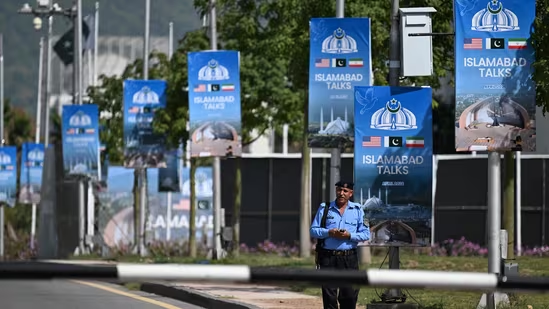
Latest reports from Iran’s state media suggest no delegation has departed from their side to Pakistan yet for negotiations with the United States.
“So far, no delegation from Iran has departed for Islamabad, Pakistan; whether it is the main or subsidiary delegation, primary or secondary,” the state TV reported.
Uncertainty has surrounded the talks, with unnamed Iranian officials telling Reuters news agency that Iran’s attendance would depend on “the change in the behaviour and positions of the Americans.”
Iranian President Masoud Pezeshkian had on Monday spoke about the “deep historical distrust in Iran” towards the US government’s “behaviour and performance.” He further cited “the non-constructive and contradictory approach” of US officials as the reason for this. A similar challenge was highlighted by Rob Malley, who was part of the team negotiating with Iran on the Joint Comprehensive Plan of Action (JCPOA) nuclear deal, which was finalised in 2015.
Also Read | Iran signals ‘new cards’ on battlefield ahead of peace talks with US, says ‘no negotiations under shadow of threats’
Malley and other negotiators who worked on finalising the JCPOA have, more than a decade later, flagged the same ‘deep mutual distrust’ and contrasting negotiating styles as reasons why the peace deal might be far from achieved, according to a NPR report.
‘Can’t negotiate with Iran in one day’: Negotiators question Trump’s approach
Wendy Sherman, the lead negotiator on the JCPOA nuclear deal with Iran, told NPR that in hindsight, the Trump administration’s approach during the first round of negotiations with Iran was all wrong.
“You cannot do a negotiation with Iran in one day…You can’t even do it in a week,” Sherman said, adding that it had taken “a good 18 months” to get the deal on JCPOA. Apart from the contrasting approaches, Malley also spoke about the different in Trump and the Iranian leadership’s attitudes. “Trump is impulsive and temperamental; Iran’s leadership [is] stubborn and tenacious,” NPR cited Malley as saying.
Malley said that apart from the inherent distrust towards America, following the attack by US-Israel and the killings of top Iranian leaders, “the level of trust is probably almost at an all-time low.” “It’s hard for them to take at their word what they’re hearing from US officials,” Malley said, adding that Tehran will be “hesitant” to give up their enriched uranium for something which is not ironclad and can be discarded. “Once they give up their stockpile… they can’t recapture it the next day,” Malley asserted.
Also Read | ‘Willfully ignorant’: White House defends Trump’s Iran strategy, claims deal ‘very close’
Patience was a ‘huge asset’ in 2015, says official
The JCPOA talks in 2015 were led by then US Secretary of State John Kerry and Iran’s then-foreign minister Mohammad Javad Zarif. Jon Finer, former US deputy national security adviser under Biden, was Kerry’s chief of staff during the JCPOA negotiations.
Finer said that Kerry’s patience was a “huge asset” in getting past the finish line. The former US Secretary of State would “endure lectures … ‘let me tell you about 5,000 years of Iranian civilization’… and just keep plowing ahead,” Finer added. “They’re just maddeningly difficult,” Finer said, adding that they would need to go back to the same issue “10 or 12 times over weeks or months” for there to be any progress.
One of the tactics of Iranian negotiators, Finer told NPR, was to “say no to everything” to see what matters the most to the US. However, Malley has cautioned against using the JCPOA talks as a guide this time around, saying that the Iranian leadership which had agreed to the deal then is no longer around, with most of them having been killed in US-Israeli strikes. “…Whatever lessons were learned in the past … have to be viewed with a lot of caution, because so much has changed,” Malley stated.