

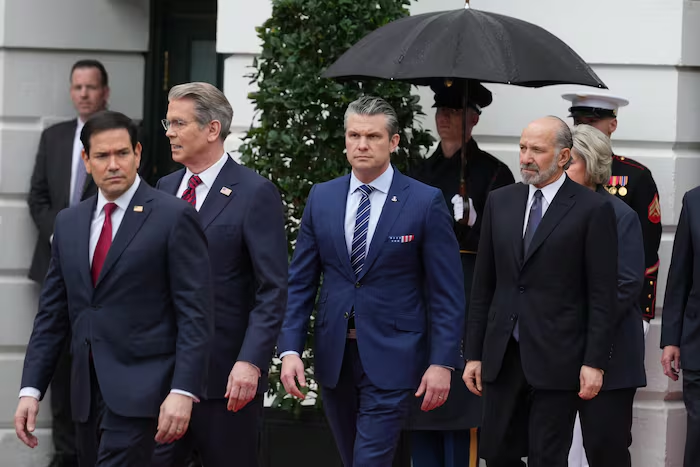
Defense Secretary Pete Hegseth said congressional Democrats are “the biggest adversary we face” as he parried questioning from lawmakers Wednesday for the first time since U.S. President Donald Trump launched the war against Iran. And the Pentagon’s chief financial officer released a detail Democrats have been demanding, saying the war has cost an estimated $25 billion and counting.
Hegseth told the House Armed Services Committee that boosting next year’s Pentagon budget to an unprecedented $1.5 trillion will “maintain the world’s most powerful and capable military.”
Meanwhile, talks on ending the war have stalled. Trump posted an image on social media showing himself carrying a weapon in a war zone, saying, “NO MORE MR. NICE GUY!”
The Latest:
Hegseth says it’s unfair to call Iran war a quagmire
The defense secretary pushed back on Democratic criticisms that the Trump administration has led Americans into a “quagmire,” pointing out that the conflict is only two months old and asserting it has had great success against the Islamic Republic. The U.S. wars in Iraq and Afghanistan dragged on for years, he said.
Trump said in early March that operations are likely to last four to five weeks but that he was prepared “to go far longer than that.”
The U.S. and Iran do appear to be locked in a stalemate. Trump seems unlikely to accept Tehran’s latest offer to reopen the strait if the U.S. ends the war, lifts its sea blockade and postpones nuclear talks. The Iranians seem unwilling to give up their nuclear ambitions before ending the conflict.
Hegseth says US military considered that Iran might close the Strait of Hormuz
He said the Pentagon “looked at all aspects” of the risk that Iran would blockade the strait. The claim came after Rep. Seth Moulton, a Democrat from Massachusetts, asked Hegseth if he considered “Iran closing the Strait of Hormuz winning.”
“I would say the blockade that we hold that doesn’t allow anything to come in or out of Iranian ports,” Hegseth replied.
So “we’ve blockaded their blockade,” Moulton said — that’s “like saying tag, you’re it.”
Caine declined to say if the risk of Iran closing the critical waterway was considered, but said the military always offers “a full range of military options that are carefully considered with the associated risks.”
The heated exchange was the latest between Hegseth and Democrats who have used the hearing to ask broader questions on the strategy behind the war in Iran and the Trump administration’s use of the military. Meanwhile, House Republicans have largely used their time asking very specific or detailed questions about the Pentagon’s budget and spending.
As TotalEnergies reports huge profits, protesters call for windfall taxes on fossil fuel companies
Climate activists protested outside a TotalEnergies petrol station in Paris on Wednesday after the French energy giant reported $5.4 billion in adjusted first-quarter profit, up 29% from a year earlier, as it “captured higher prices” despite production challenges due to the war in Iran.
The 350.org group said about 30 activists from several environmental organizations unfurled a banner reading, “TotalEnergies profits, we foot the bill.”
The group said war-related price spikes have cost French consumers and businesses more than $2.3 billion so far, urging the French government to “show political courage” by permanently taxing excess fossil fuel profits.
“While families watch their bills skyrocket, TotalEnergies posts some of its best financial results without even paying its fair share of taxes,” 350.org country manager Fanny Petitbon said in a statement. “We are witnessing an obscene transfer of wealth: the war enriches shareholders as it impoverishes citizens.”
Hegseth claims Americans support Iran war despite polling
The hearing has resumed, with a heated exchange between Democratic Rep. John Garamendi and Hegseth.
The secretary said the American people have supported the war’s mission of depriving Iran of a nuclear weapon, “despite your loose talk and words like quagmire.”
While an AP-NORC poll from March found that about two-thirds of U.S. adults said it’s “extremely” or “very” important to prevent Iran from obtaining a nuclear weapon, other polling suggests that most Americans disapprove of how Trump is handling the issue of Iran more broadly.
Garamendi had lambasted Hegseth and Trump for the Iran war, calling it “a political and economic disaster at every level.”
1.24 million projected to face acute insecurity in Lebanon, UN report says
That’s nearly one in four of the population analyzed, according to the latest Integrated Food Security Phase Classification (IPC) analysis released by Lebanon’s Agriculture Ministry with the UN’s Food and Agriculture Organization and the World Food Program.
The figures are projections and it remains unclear how the estimates were reached. The report notes that the current crisis follows seven years of compounded economic collapse and conflict.
“Compounded shocks are undermining agricultural livelihoods and impacting food security, highlighting the urgent need for emergency agricultural assistance to support farmers,” said Nora Ourabah Haddad, FAO Representative in Lebanon.
US energy secretary says ‘good on them’ after UAE announced it’s leaving OPEC
The United Arab Emirates is “a dynamic rising nation, a great ally of the United States,” Chris Wright said at a press conference in Croatia. “But they are a sovereign nation, they’ve invested massively in their own energy infrastructure, and apparently they want more flexibility about how to deploy that infrastructure.”
Both UAE and Saudi Arabia have been “great partners in investing hugely to power not just their nations and the region, but they are major energy suppliers to the whole globe,” Wright added. “A lot of our standard of living is massively benefited by the investments of the UAE and Saudi Arabia and Qatar and Kuwait and many of the nations in that region.”
Wright expressed confidence that as the oil flow starts to be unimpeded again after this conflict, “everyone that has spare oil production capacity will lean in and produce as much energy as they can.”
EU commissioner sees ‘no actual evidence’ of fuel shortages due to blockade of Strait of Hormuz
Transport Commissioner Apostolos Tzitzikostas said Wednesday commercial jet fuel stocks are markets are “under pressure in certain parts of Europe” and that the 27-member bloc maintains emergency fuel reserves that can be utilized “only if necessary.”
Tzitzikostas didn’t elaborate on when the EU will need to tap those emergency reserves, or offer any figures regarding current stocks.
But he said the EU is enacting a series of measures to dampen the impact of the blockade, including working to secure alternative fuel supplies from the U.S. and to establish a fuel observatory to monitor fuel supply and stock levels.
Joint Staff Chairman says Trump is making ‘tradeoffs’ in focusing military on Iran
Trump ordered three aircraft carriers into the Middle East — a number not seen since 2003. When asked why the U.S. military withdrew resources from Asia after identifying China as a top threat, the president’s top military advisor told lawmakers that Trump has to make “tradeoffs” when deploying troops.
“I’m confident that the president always carefully considers these readiness tradeoffs and I’m sure he has done so in this case based on the military options that we’ve presented with the associated risks and advice,” Caine said.
Rep. Joe Courtney, a Democrat, fired back by noting that the administration’s own National Defense Strategy released shortly before Trump launched the war said Iran was “weaker and more vulnerable than it has been in decades.” Putting that many troops to confront them, at the expense of other threats “does not, in my opinion, common sense,” Courtney said.
Hegseth engages in tense exchange over Iran’s nuclear program
Hegseth told Democratic Rep. Adam Smith that Iran’s nuclear facilities were obliterated in a 2025 attack by the U.S., prompting Smith to question the Trump administration’s reasoning for starting the Iran war.
“We had to start this war, you just said 60 days ago, because the nuclear weapon was an imminent threat,” Smith said. “Now you’re saying that it was completely obliterated?”
Hegseth responded by saying that Iran “had not given up their nuclear ambitions” and still had thousands of missiles.
Smith said the war “left us at exactly the same place we were before.”
Committee takes a break
The committee is taking a brief recess to vote, which is expected to take about 20-25 minutes.
Top defense official says Iran war costs are estimated at $25 billion so far
During a hearing of the House Armed Services Committee, Jules Hurst III, the acting undersecretary of war for finances, said most of the expense has been on munitions, but the military has also spent money on running the operations and equipment replacement.
“We will formulate a supplemental through the White House that will come to Congress once we have a full assessment of the cost of the conflict,” Hurst added.
Caine says his goal is to tell civilian leaders what they need to hear
The Chairman of the Joint Chiefs of Staff told the committee in his opening statement that he wants to emulate Gen. George C. Marshall, who served during World War II and later helped Europe recover from the conflict.
“His commitment to civilian control and military and nonpartisan military remains a constant standard in something I borrow from often,” Caine said. “I strive daily to emulate his candor, delivering the facts to our leaders and telling them always what they need to hear, not always what they want to hear.”
Hegseth slams Iran war critics as ‘biggest adversary we face’
“The biggest challenge, the biggest adversary, we face at this point are the reckless, feckless and defeatist words of congressional Democrats and some Republicans,” the U.S. defense secretary told lawmakers on the House Armed Services Committee.
Rep. Adam Smith, the ranking Democrat, told Hegseth that he finds it “absurd” to claim that the Pentagon’s strategy is built on realism when the war in Iran seems like “the exact opposite of realism.”
Smith also said Hegseth needs to explain what the Trump administration’s goals were for the conflict.
“We’ve seen the cost, and the cost is very, very high,” he said.
Hegseth argued that the historically high Pentagon budget request will maintain “the world’s most powerful and capable military as we grapple with a complex threat environment across multiple theaters.”
Democratic lawmakers calls on Hegseth to answer where the Iran war is going
Rep. Adam Smith, the top Democrat on the House Armed Services Committee, told Defense Secretary Pete Hegseth that he finds it “absurd” to claim that the Pentagon’s strategy is built on realism.
“We started a full scale war in the Middle East against Iran to try to reshape the Middle East,” Smith said, adding that was the exact opposite of realism.
Smith said Hegseth needs to provide an explanation of what the Trump administration’s goals are in the Middle East.
“Where is this going? What is the plan to achieve our objectives? We’ve seen the cost, and the cost is very, very high,” he said.
Republican House armed services chair praises Trump’s historic military budget
Mike Rogers, the chair of the House Armed Services Committee, praised Trump’s $1.5 trillion plan to fund the military in 2027, stating that it “accounts for the true cost of American deterrence.”
“This will enable us to truly catch up in our modernization efforts by quickly fielding new munitions, aircraft, ships, land, space and autonomous systems to replenish and expand our arsenal,” Rogers said.
Pete Hegseth hearing is underway
A House hearing with the defense secretary has started with a packed hearing room and many other people crowded into the hallway outside.
“Let the public in,” several people chanted outside as lawmakers found their seats. They also yelled at Hegseth as he passed them in the hallway.
The hearing is officially to discuss the Pentagon’s proposed budget, but it will also be the first time that Hegseth publicly answers questions on the Iran war on Capitol Hill. Joint Chiefs of Staff, Gen. Dan Caine, is seated beside the defense secretary.
A deal between the US and Iran will take ‘political will’
Grossi said the IAEA participated in U.S.-Iran nuclear talks in February, but not the ceasefire negotiations mediated by Pakistan. He said the agency has been in discussions separately with the U.S. and informally with Iran.
The latest proposal from Iran would postpone discussions on its nuclear program but end its chokehold on the Strait of Hormuz if the U.S. lifts its blockade and ends the war.
Grossi described that as an indication Iran wants to sequence how it confronts the objectives mandated by the U.S., including curbing its ballistic missile program and dealing with its proxies Hezbollah in Lebanon, Hamas in Gaza and the Houthis in Yemen.
“Where the frustration kicks in, apparently for both, is that they do not seem to come to agreement, or be at an eye-to-eye level on what needs to be done first, or on how,” he said.
IAEA has talked to Russia and others about taking Iran’s highly enriched uranium
The U.N. nuclear watchdog believes a large percentage of Iran’s highly enriched uranium was stored at Isfahan when Israel and the U.S. bombarded Iran in June 2025, “and it has been there ever since,” Grossi said.
Grossi said the IAEA has discussed with Russia and others the possibility of sending Iran’s highly enriched uranium out of the country — a complex operation that would require either a political agreement or a major U.S. military operation in hostile territory.
“What’s going to be important is that that material leaves Iran” or is blended to reduce its enrichment, he said.
Iran’s highly enriched uranium likely is at the Isfahan site, the UN nuclear chief tells the AP
The majority of Iran’s highly enriched uranium is likely still at its Isfahan nuclear complex, which was bombarded by U.S. airstrikes last year and faced less intense attacks in this year’s U.S.-Israeli war, the head of the U.N. nuclear agency told The Associated Press.
Rafael Grossi said in an interview on Tuesday that the International Atomic Energy Agency has satellite images showing the effects of the latest U.S.-Israeli airstrikes against Iran and that “we continue to get information.”
Iran has 440.9 kilograms (972 pounds) of uranium that is enriched up to 60% purity, a short, technical step from weapons-grade levels of 90%, according to the agency. Grossi has said the IAEA believes roughly 200 kilograms (about 440 pounds) is stored in tunnels at the Isfahan site. The stockpile could be weaponized into as many as 10 nuclear bombs, Grossi told the AP last year.
Moscow praises OPEC as stabilizing force as UAE announces plans to leave
Speaking to journalists Wednesday, Kremlin spokesperson Dmitry Peskov said that Russia had no plans to leave OPEC+ and praised the organization’s work in stabilizing energy markets.
“This is a very important area of work and it is especially crucial at the current moment, when energy markets are, to put it mildly, in turmoil,” he said.
However, he stressed that Moscow respected the UAE’s decision. “We welcome statements from Abu Dhabi that the Emirates will continue to take a responsible position in the energy market,” Peskov said.
Merz says relationship with Trump is ‘as good as ever’
German Chancellor Friedrich Merz said his relationship with President Donald Trump remains “as good as ever,” but that he had “had doubts from the very beginning about what was started there with the war in Iran.”
“We are suffering considerably in Germany and in Europe from the consequences of, for example, the closure of the Strait of Hormuz,” Merz said on Wednesday. This hurts energy supplies and the economy. “And in that regard, I urge that this conflict be resolved.”
Trump had earlier attacked Merz on his Truth Social platform: “The Chancellor of Germany, Friedrich Merz, thinks it’s OK for Iran to have a Nuclear Weapon. He doesn’t know what he’s talking about!” Trump wrote.
Trump was responding to Merz’s comments on Monday, when the German Chancellor said the U.S. was being “humiliated” by the Iranian leadership and criticized Washington’s lack of strategy in the war.
Trump says Iran ‘better get smart soon’
U.S. President Donald Trump criticized Iran’s handling of nuclear negotiations, saying it has failed to move toward a deal.
“Iran can’t get their act together. They don’t know how to sign a nonnuclear deal. They better get smart soon!” he wrote on Truth Social.
Trump’s post featured an AI-generated image of himself holding a weapon amid explosions with the caption “NO MORE MR. NICE GUY.”
Tensions over Tehran’s nuclear program rose before the war broke out, with Trump repeatedly vowing to ensure the country can’t build a nuclear weapon. Iran long has insisted its nuclear program is peaceful, though it enriched uranium to nearly weapons-grade levels.
Iran has carried out at least 21 executions since start of war
The U.N.’s human rights chief said Iran has executed at least 21 people since the start of the war with the United States and Israel on Feb. 28.
Volker Türk says at least nine people were executed in connection with huge protests across Iran in January, while another 10 were executed for alleged membership in opposition groups, and two others on espionage charges.
More than 4,000 people have been arrested on national security-related charges in Iran since the end of February, his office says.
Lebanese army soldier killed in Israeli strike
A Lebanese army soldier was killed Wednesday along with his brother in an Israeli strike that targeted the motorcycle on which they were traveling from the soldier’s work post to his home in the village of al-Souaneh, the army said in a statement.
The Lebanese army has stood on the sidelines during the latest Israel-Hezbollah war, which began on March 2 when the militant group launched a salvo of missiles into Israel, two days after the U.S. and Israel launched their attacks on Iran. But soldiers have frequently gotten caught in the crossfire.
A total of 20 Lebanese army soldiers have been killed by Israeli strikes since March 2, most of them while en route to or from their duty stations, the army said. Altogether, more than 2,500 people have been killed in Lebanon during the war and during a shaky ceasefire implemented earlier this month that has reduced but not halted the fighting.
Iran’s highly enriched uranium likely at Isfahan, IAEA says
The majority of Iran’s highly enriched uranium is likely still at its Isfahan nuclear complex, which was bombarded by airstrikes last year and faced less intense attacks in this year’s U.S.-Israeli war, the head of the U.N. nuclear agency told The Associated Press.
Rafael Grossi said in an interview on Tuesday that the International Atomic Energy Agency has satellite images showing the effects of the latest U.S.-Israeli airstrikes against Iran and that “we continue to get information.”
IAEA inspections ended at Isfahan when Israel last June launched a 12-day war that saw the United States bomb three Iranian nuclear sites.
The U.N. nuclear watchdog believes a large percentage of Iran’s highly enriched uranium “was stored there in June 2025 when the 12-day war broke out, and it has been there ever since,” Grossi said.
Pakistan’s weekly oil bill rises to $800M from $300M before Iran war
Pakistan’s weekly oil import bill has surged by about 167% due to soaring global prices, adding strain to the cash-strapped nation’s fragile economy, Prime Minister Shehbaz Sharif said Wednesday.
In televised remarks during a Cabinet meeting, Sharif said the weekly oil import bill had risen from $300 million before the conflict to $800 million.
He said the government is taking steps to conserve energy and reduce oil consumption, and that diplomatic efforts to promote peace are still ongoing.
Iran’s rial currency hits record low
Iran’s national rial currency hit a record hit Wednesday of 1.8 million to $1 as a shaky ceasefire with the U.S. and Israel still holds.
The rial had remained stable for weeks during the war, which began Feb. 28, in part because there was little trading or imports coming into the country.
The rial began to slide two days ago, hitting the record low Wednesday.
Experts warn the fall of the rial is likely to further fuel inflation in a country where many imported goods, from food and medicine to electronics and raw materials, are affected by the dollar rate.
The war is now in a ceasefire, but a U.S. blockade has continued to increase pressure on Iran’s already-battered economy, cutting into a key source of government revenue and hard currency by stopping or intercepting oil shipments.
Pakistan continuing efforts to ease US-Iran tensions, PM says
Pakistan’s Prime Minister Shehbaz Sharif said Wednesday his government is continuing efforts to help ease tensions between the United States and Iran.
Speaking during a Cabinet meeting in Islamabad, he said a “marathon session” was held in the capital during an initial round of direct talks between the two sides on April 11, leading to progress on a ceasefire that remains in place.
He said Iran’s Foreign Minister Abbas Araghchi visited Pakistan over the weekend during the ceasefire, where another extended round of talks took place between Iran and Pakistan. Araghchi later traveled to Oman, returned briefly, and then departed for Russia, Sharif said.
Sharif said before leaving for Moscow, Araghchi spoke to him by phone and “assured me that after consulting with his leadership, he would respond as soon as possible.” He did not specify what Araghchi would respond to, but Pakistan has said it is seeking to host a second round of talks between the United States and Iran.
Hegseth to face Congress for the first time since Iran war began
U.S. Defense Secretary Pete Hegseth will face questioning from members of Congress for the first time since the Iran war began.
The hearing Wednesday before the House Armed Services Committee will focus on the Trump administration’s $1.5 trillion military budget for 2027.
Democratic lawmakers are likely to grill Hegseth on the Iran war’s costs and huge drawdown of critical munitions. While a ceasefire is now in place, the U.S. and Israel launched the war Feb. 28 without congressional oversight.
Copyright 2026 The Associated Press. All rights reserved. This material may not be published, broadcast, rewritten or redistributed without permission.