

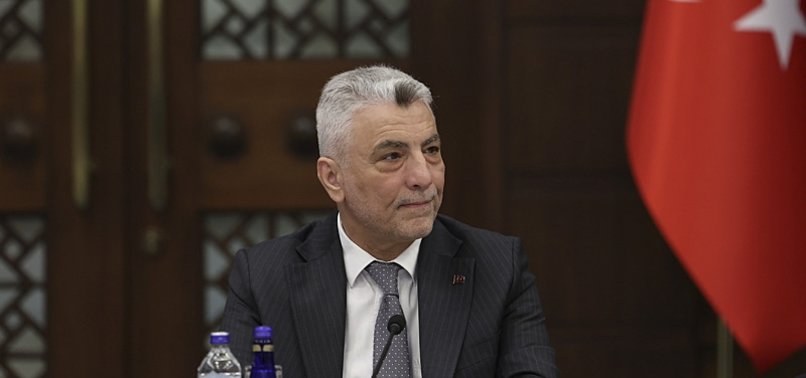
Türkiye‘s trade and technology ministers on Monday outlined the country’s path to global competitiveness, green energy and international investment.
Speaking at the Powerhouse for Investment in the Türkiye Century press conference in the capital Ankara, Trade Minister Ömer Bolat highlighted key measures taken to support export sectors and draw foreign direct investment.
Since 2021, he said, Türkiye has aligned its industrial regulations with the EU Carbon Border Adjustment Mechanism and Green Deal criteria, a landmark policy designed to prevent carbon leakage.
The government has coordinated closely with private sector representatives to adapt key industries such as cement, steel, fertilizer, energy and textiles to the new environmental standards, he said.
Bolat further said Türkiye has invested roughly $300 billion in transportation and $200 billion in energy infrastructure under the leadership of President Recep Tayyip Erdoğan.
Taking advantage of its strategic geographic location, he said, Türkiye has explored alternative trade routes via neighboring countries.
Those efforts have borne fruit, he said, adding that the country attracted $300 billion in foreign direct investment over the last 23 years.
TECH VISA PROGRAM AND GREEN ENERGY GOALS
Industry and Technology Minister Mehmet Fatih Kacır said the country eliminated bureaucratic obstacles for establishing digital companies under the Tech Visa program.
Kacır stated that international investors can now set up businesses remotely through a passport-based identity verification process.
He noted that entrepreneurs gain access to virtual office services and automated accounting infrastructures to reduce operational costs significantly.
He said 13,000 companies currently operate across 114 technology parks in Türkiye with state support.
He stressed that the nation has opened a new window of opportunity to attract global talent by leveraging its strong entrepreneurship ecosystem and advanced defense industry capabilities.
Kacır reported that the Tech Visa program successfully brought over 5,000 digital talents to the country in its first year by granting work permits within two weeks.
He highlighted that digital company members receive special privileges, providing access to a world-class entrepreneurship center under the Terminal Istanbul project.
The government plans to offer tax exemptions and financial incentives to eligible companies until they scale up.
Kacır reaffirmed that green transformation remains a primary strategy as the country actively supports the industrial shift toward renewable energy.
He said that Türkiye reached an installed capacity of 23 gigawatts in solar energy and 13 gigawatts in wind power.
Kacır went on to say the nation expects to achieve 80 gigawatts of solar and 40 gigawatts of wind energy production by 2035.
He underlined new regulations approved by parliament to facilitate and support investors for renewable energy projects.
He said the Russian-powered Akkuyu Nuclear Plant will begin production later this year.
He revealed plans for two additional nuclear investments, aiming for 20 gigawatts from conventional plants and 50 gigawatts through small modular reactors.
He said a new program is being developed for small modular reactor technologies.