
Türkiye expanding its diplomatic role as Antalya Diplomacy Forum serves as major draw for global leaders: Foreign minister

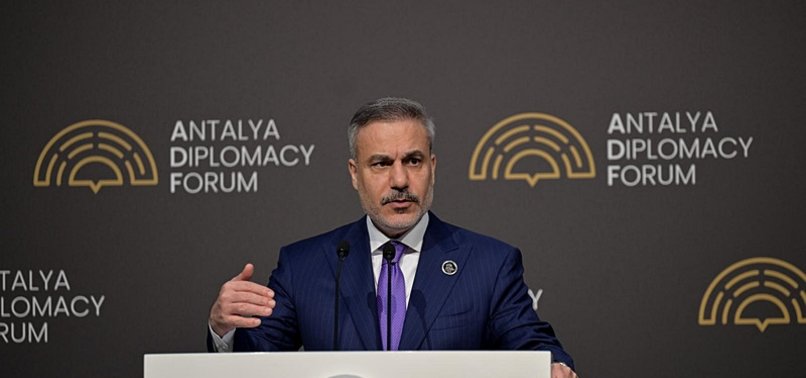
This weekend’s Antalya Diplomacy Forum brought together thousands of global leaders and served as a key platform for addressing major international crises, said Turkish Foreign Minister Hakan Fidan on Sunday, also stressing Türkiye’s expanding diplomatic and mediation role.
Speaking at the closing press conference of the three-day forum in the southern Turkish city of Antalya, Fidan said 23 heads of state and government, 13 deputy leaders, and 50 government ministers attended the event alongside representatives from 150 countries and 66 international organizations.
“Over three days, Antalya once again became a center where the pulse of global diplomacy was felt,” Fidan said, adding that 6,400 participants joined 52 sessions covering crises from the Asia-Pacific to Latin America, Europe, and Central Asia.
Fidan said President Recep Tayyip Erdoğan, along with senior Turkish officials and their foreign counterparts, held numerous bilateral meetings on the sidelines of the forum, while several critical diplomatic gatherings were also hosted there.
QUADRILATERAL MEETING WITH PAKISTAN, SAUDI ARABIA, EGYPT
Fidan confirmed that Türkiye held a quadrilateral meeting with Pakistan, Saudi Arabia and Egypt focused on regional stability, cooperation, and maritime security.
“Our goal is for these four countries to address regional issues with a realistic and implementable agenda,” he said.
Fidan denied claims that the talks were aimed at forming a military alliance, saying Türkiye is focused on stability and economic development rather than confrontation.
“We are not forming alliances against others. We are seeking how to end conflicts, advance economic progress, and ensure stability in our region,” he said.
Fidan added that the four countries represent a broader regional structure and emphasized that stronger cooperation could unlock the region’s potential.
“If the region continues waiting for external help, it will continue facing the same problems indefinitely,” he said.
IRAN-US TALKS AND CEASEFIRE EFFORTS
Fidan said Türkiye is closely monitoring negotiations between Iran and the US, with Pakistan playing a mediation role.
“We have reached a critical stage in the talks. Both sides are continuing negotiations with serious intent,” he said.
Fidan expressed optimism that the ceasefire would be extended.
“No one wants a new war. The international community is urging both sides to extend the ceasefire and continue negotiations,” Fidan said.
GAZA PEACE PLAN AND ISRAEL POLICIES
Fidan said a separate meeting of six Muslim countries also addressed the Gaza peace plan and reaffirmed their joint commitment to achieving lasting peace.
“Israel’s intention to depopulate Gaza, whether by killing or displacement, is known by everyone,” Fidan said.
He described Israel’s expansionist policies as a growing global security threat.
“This is no longer just a regional issue but a global security problem,” he added.
Fidan said diplomatic efforts are ongoing to prevent further escalation and improve humanitarian conditions in Gaza.
RUSSIA-UKRAINE WAR
Fidan said Türkiye remains ready to host further Russia-Ukraine peace talks.
“The war entering its fifth year must end. We are ready to host meetings again, whether at the technical or leadership level,” he said.
Fidan warned that global attention shifting to other crises should not reduce focus on Ukraine.
“We must not allow attention to shift away from Ukraine and Gaza,” he added.
SOUTH CAUCASUS PEACE PROCESS
Fidan also said Armenia and Azerbaijan have made significant progress toward a peace agreement.
“Both sides are sincere in pursuing peace. With a final agreement, the region will become much more stable,” he said.
Fidan noted that normalization between Azerbaijan and Armenia could also advance Türkiye-Armenia normalization and strengthen regional connectivity.
He highlighted the importance of the Middle Corridor and the Zangezur corridor — connecting Azerbaijan to its exclave of Nakhchivan — for trade and energy security.
“With a final agreement, we expect major positive developments in connectivity, economic growth, and energy security,” Fidan said.
LEBANON AND REGIONAL STABILITY
Fidan also warned that Israel’s military operations in Lebanon risk further destabilizing the region.
“More than one million people have been displaced. This is not only a humanitarian issue but also a serious threat to regional stability,” he said.
He added that global attention shifting to other crises could allow further escalation.
“We cannot allow this to become a fait accompli,” Fidan said.
AFRICA DIPLOMACY AND MEDIATION EFFORTS
Fidan highlighted Türkiye’s growing diplomatic engagement in Africa, including mediation and security cooperation.
“We are pursuing a two-track strategy in Africa, economic cooperation, and conflict resolution,” he said.
He cited Türkiye’s support for Somalia’s counterterrorism efforts, cooperation with Nigeria, mediation between Somalia and Ethiopia, and support for peace in Libya and Sudan.
Fidan added that Türkiye is also monitoring tensions between Rwanda and the Democratic Republic of Congo.
“Africa has never left our radar,” he said.
ENERGY SECURITY AND CONNECTIVITY PROJECTS
Fidan said recent tensions around the Strait of Hormuz highlighted the importance of alternative connectivity and energy transport routes.
“Projects linking the Gulf through Syria and Türkiye to international markets are gaining importance,” he said.
He added that rail and land transport projects between Türkiye, Syria and Saudi Arabia are being discussed.
“Our leaders focus on connectivity, energy security and development, not conflict,” Fidan said.
MIDDLE POWERS AND GLOBAL GOVERNANCE
Fidan said middle-power countries are increasingly coordinating to manage global crises.
“Regional crises are now producing global effects. The distinction between regional and global crises is disappearing,” he said.
Fidan noted that Türkiye is strengthening cooperation with countries such as Japan, South Korea, Australia, the UK, France, and Canada.
“Middle powers must work together to address global challenges,” he added.
FORUM’S ROLE
Fidan said the forum also addressed emerging global challenges, including artificial intelligence, critical minerals, food security, climate change, and geopolitical competition.
“At a time when polarization is replacing dialogue, the Antalya Diplomacy Forum has become a rare platform for hope, dialogue and solutions,” he said.
He reaffirmed Türkiye’s commitment to diplomacy and mediation.
“We will continue to diversify cooperation, build trust, and bring parties closer together,” Fidan said.
“Türkiye’s attraction as a diplomatic center will continue to grow,” he added.
Fidan concluded by thanking participants, institutions, and media organizations for contributing to the forum’s success before opening the floor to questions.
Anadolu served as communications partner for the three-day forum.