

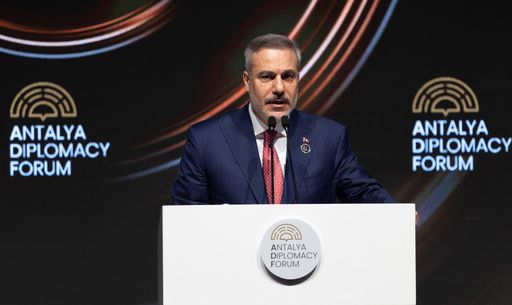
Türkiye’s Foreign Minister Hakan Fidan has emphasised the importance of “putting out the fire” in the region and expressed hope that the US-Iran ceasefire will be transformed into a lasting peace.
“It is our sincere hope that the ceasefire achieved will be fully implemented and that the process will be transformed into a lasting peace,” Fidan said on Friday during his address at the Antalya Diplomacy Forum, referring to a 14-day ceasefire between the US and Iran on April 8 and Pakistan’s efforts to restart Washington-Tehran talks after the first round in Islamabad failed.
Warning that the world is facing multidimensional threats that trigger one another every day, Fidan said that “uncertainty and crisis have now become defining features of our age.”
Touching on last year’s theme, which focused on the ongoing genocide in Gaza and its global repercussions, Fidan said this year’s theme is the war in Iran and its effects on the world.
“The profound damage to the international system and the continuous escalation have left our region facing one of the most serious trials in its recent history. In this process, humanity has once again learned, at a heavy price, that war has no winner. Undoubtedly, there are historic lessons to be drawn from this war by all, foremost by the countries of the region,” he added.
Praising those who contributed to the two-week ceasefire between the US-Israel and Iran, particularly Pakistani Prime Minister Shehbaz Sharif, Fidan urged that the core issue underlying the war should not be overlooked.
Pointing out the “direct” threat posed by Israel’s expansionism to the world, which has begun with genocide in Gaza, Fidan urged “those who wish lasting peace both in the region and beyond it” to stop Israel.
He underlined that the international community had demonstrated a rare consensus in efforts to halt the war.
“We must make every effort to use such a valuable opportunity in favour of dialogue and diplomacy. Indeed, this approach lies at the very core of the Antalya Diplomacy Forum: to make diplomacy work again,” he said.
“In our understanding, diplomacy is the will to stop the fire before it spreads further. It is the ability to patiently mend broken ties. It is the courage to prevent hostilities from becoming fatal. It is the art of preserving and expanding the minimum common ground for a shared future. In other words, diplomacy is about shaping tomorrow.”
Fidan said that shaping the future depends on two main pillars.