

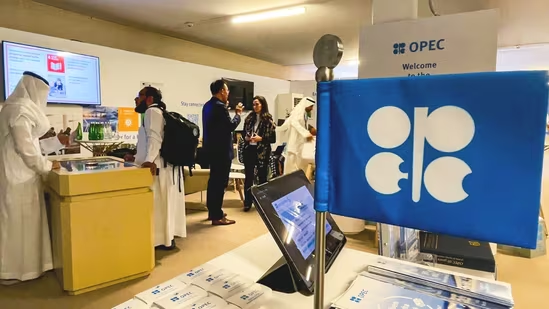
The United Arab Emirates on Tuesday said it will exit the oil cartel OPEC and its wider OPEC+ grouping effective May 1, a move long anticipated as the country grew increasingly frustrated with production limits and its strained ties with neighbouring Saudi Arabia.
The decision comes at a time when the Iran war has already triggered a historic energy shock and unsettled the global economy.
The Gulf nation’s energy minister said that stepping away from the group would give the country greater flexibility, as it would no longer be bound by collective obligations, BBC reported.
The departure follows years of friction with Saudi Arabia, the de facto leader of OPEC, over oil production policy as well as broader regional influence.
The two countries have clashed at OPEC meetings in the past, with the UAE pushing to utilise its expanded production capacity while Saudi Arabia advocated for supply restraint. These disagreements had previously brought Abu Dhabi close to exiting the group, though it had stopped short of doing so until now.
Also Read | UAE leaves OPEC and OPEC+ in huge blow to global oil producers’ group
UAE’s recent developments and OPEC exit
In recent years, the UAE has sought to assert a more independent foreign policy in the Middle East, at times diverging from Riyadh’s positions. Frictions have also grown as Saudi Arabia, under Crown Prince Mohammed bin Salman, stepped up efforts to attract foreign investment, directly competing with the Emirates.
The UAE has been a longstanding member of OPEC, initially through Abu Dhabi’s entry in 1967 and later as a unified nation after its formation in 1971.
The announcement was made via the UAE’s state-run WAM news agency.
Follow here for live updates
‘Beginning of the end of OPEC’
Saul Kavonic, head of energy research at MST Financial, described the move as “the beginning of the end of Opec”.
“With the UAE leaving, Opec loses about 15% of its capacity and one of its most compliant members,” the BBC report added.
According to the latest OPEC figures, the UAE produces around 2.9 million barrels of oil annually, compared with Saudi Arabia’s roughly nine million barrels.
“Saudi Arabia will struggle to keep the rest of Opec together, and effectively have to do most of the heavy lifting regarding internal compliance and market management on its own,” Kavonic said, adding that other members may follow.
“This present a fundamental geopolitical reshaping of the Middle East and oil markets,” he added.
Iran war and UAE’s exit
The move also signals how the war in Iran could reshape global energy markets in the long term. While the UAE has previously considered leaving OPEC amid persistent tensions with Saudi Arabia, Energy Minister Suhail Al Mazrouei said in an interview that disruptions caused by the war created the right moment to act.
“This is a decision that we took after a very careful and long review of all our strategies,” he said. “The decision is taken at the right time in our view because it’s not going to hugely impact the market: the market is undersupplied.”
He added that supply shortages linked to the war require quicker responses to market demand, which would be easier outside the group’s collective decision-making framework.