

Israel’s military on Saturday said it has established a “Yellow Line” demarcation in southern Lebanon – a boundary it says mirrors a similar separation used in Gaza.
The development comes just days after Israel and Lebanon agreed to a 10-day ceasefire aimed at halting weeks of fighting between Israel and the Iran-backed Hezbollah.
Referring to the newly established “Yellow line” for the first time, the Israeli military said its forces identified individuals approaching from beyond it.
“Over the past 24 hours, IDF forces operating south of the Yellow Line in southern Lebanon identified terrorists who violated the ceasefire understandings and approached the forces from north of the Yellow Line in a manner that posed an immediate threat,” news agency AFP quoted the Israeli forces as saying.
The military added that it acted swiftly. The IDF said its “forces attacked the terrorists in several areas,” adding that “actions taken in self-defence and to remove immediate threats are not restricted by the ceasefire.”
What is the ‘Yellow Line’?
The “Yellow Line” is essentially a military demarcation – a notional boundary drawn on the ground to separate opposing zones of control. Israel says it has now created such a line in southern Lebanon, marking the limit between its forces and areas beyond which potential threats could emerge.
A similar “Yellow Line” has been in place in Gaza since October 10, where it effectively split the territory into two parts: one under Israeli military control and the other under Hamas. By invoking the same term in Lebanon, Israel appears to be applying a familiar operational framework to manage troop movement and perceived threats along a volatile front.
Israel says ‘terrorists’ crossed line, posed a threat
Airstrikes target ‘terrorist cell’
In a separate update later in the day, the military said its air force carried out strikes near the same zone.
“The IDF eliminated a terrorist cell operating in proximity to IDF soldiers in southern Lebanon, in the area of the forward defence line,” it said, again referring to the Yellow Line.
It did not specify how many militants were killed.
“Additionally, the IDF struck an underground shaft in the area south of the forward defence line, as well as Hezbollah terrorists who were identified entering it. A hit was identified,” it added.
Ceasefire in place, but tensions remain
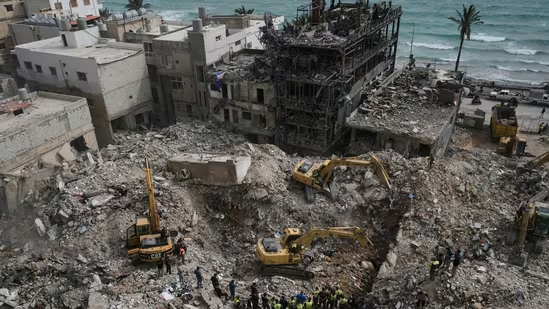
The announcement comes against the backdrop of a fragile ceasefire agreed on Thursday, meant to pause six weeks of intense conflict. The fighting saw widespread Israeli airstrikes across Lebanon and a ground offensive in the south.
Hezbollah has said it halted operations after the ceasefire took effect, but warned it was keeping its “finger on the trigger” in case of violations.
Lebanese President Joseph Aoun has called for talks, saying “direct negotiations” with Israel “are crucial,” with the aim to “consolidate a ceasefire, secure the withdrawal of Israeli forces from the occupied southern territories, recover prisoners and address outstanding border disputes”.
From Washington, Donald Trump said the US had “prohibited” Israel from bombing Lebanon after the ceasefire, adding that it would work with Lebanon to “deal with” Hezbollah.
However, Israeli Prime Minister Benjamin Netanyahu struck a more hardline note, saying Israel had not “yet finished the job” against Hezbollah and would continue efforts toward the group’s “dismantling”.
According to Lebanese authorities, the war, which began on March 2, has killed nearly 2,300 people and caused extensive damage, particularly in southern cities like Nabatiyeh, reported AFP.