

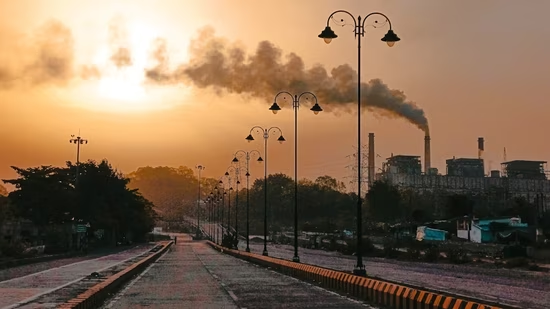
A new report shows the state of air quality across the United States, identifying the metro areas facing the most severe pollution challenges in 2026.
The 27th annual “State of the Air” report by the American Lung Association evaluates ozone and particle pollution levels across counties, states and metropolitan regions.
Ground-level ozone remains one of the most persistent threats to air quality in urban America. Formed when emissions from vehicles, industrial facilities and other sources react in sunlight, ozone is a major component of smog.
Experts warn that rising temperatures are worsening the problem. Warmer conditions accelerate ozone formation, leading to more frequent spikes during summer months. These increases often trigger health advisories, particularly in densely populated cities.
Vulnerable groups, including children, the elderly and those with respiratory conditions, face the greatest risk. Prolonged exposure has been linked to asthma attacks, cardiovascular disease and other serious health issues.
Also Read: Global temperatures breach 1.5°C threshold for 1st time in 3 years in a row
California cities dominate rankings
The report’s rankings show a strong concentration of the most polluted cities in California, with Los Angeles-Long Beach, CA taking the top spot as the most ozone-polluted metro area in the country.
It is followed by Visalia, CA and Bakersfield-Delano, CA, both of which also report high levels of particle pollution. Several other California regions, including Fresno-Hanford-Corcoran and San Diego-Chula Vista-Carlsbad, feature prominently.
“Despite decades of progress, too many people throughout California are living with unhealthy levels of air pollution,” said Will Barrett, assistant vice president for nationwide clean air policy at the American Lung Association.
Also Read: Weather Bee: How much global warming to expect in 2026
Major metros across the US impacted
Outside California, other major urban areas also rank among the worst for air pollution. Phoenix-Mesa, AZ (4th), Houston-Pasadena, TX (6th) and Denver-Aurora-Greeley, CO (8th) are among those reporting high ozone levels.
Industrial activity continues to be a major factor in cities like Houston, where emissions from petrochemical facilities contribute significantly to pollution levels.
Meanwhile, large metropolitan regions such as New York-Newark, NY-NJ-CT-PA (12th) and Chicago-Naperville, IL-IN-WI (15th) also feature on the list.
Full list of worst-affected cities
The 15 US metro areas with the worst air pollution in 2026 are:
Los Angeles-Long Beach, CA
Visalia, CA
Bakersfield-Delano, CA
Phoenix-Mesa, AZ
Fresno-Hanford-Corcoran, CA
Houston-Pasadena, TX
San Diego-Chula Vista-Carlsbad, CA
Denver-Aurora-Greeley, CO
Dallas-Fort Worth, TX-OK
El Centro, CA
Las Vegas-Henderson, NV
New York-Newark, NY-NJ-CT-PA
Salt Lake City-Provo-Orem, UT-ID
San Jose-San Francisco-Oakland, CA
Chicago-Naperville, IL-IN-WI
The report states that around 33.5 million children in the US, which is nearly 46% of those under 18, live in areas that received a failing grade for at least one measure of air pollution.