

Blake Anderson found the perfect New York City office for his AI-powered mobile-app-development company, 10x.
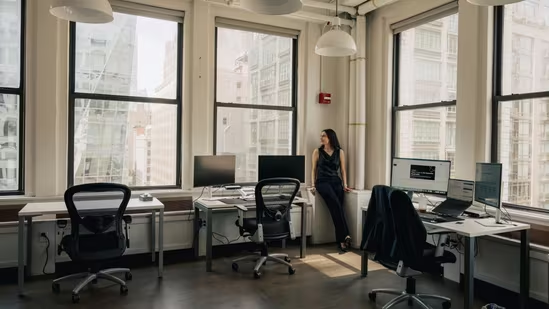
The airy SoHo loft features high ceilings and hardwood floors. It is located in the heart of Manhattan’s startup scene, not far from OpenAI’s outpost. Anderson pays $28,500 a month for the 3,000-square-foot space, which holds 30 desks and an area for videogame breaks.
All that is missing are employees.
The 25-year-old founder had only one when he signed the yearlong lease in December. He recalled walking into the office and being surrounded by empty desks. “And it was like: Man, are we swinging too high?” Anderson said.
Cash-rich AI startups are fueling a new boom in Manhattan’s commercial real-estate market. In 2025, artificial-intelligence companies signed leases for more than 845,000 square feet, according to real-estate-services firm JLL. This year, they are leasing at nearly double that rate, securing more than 414,000 square feet in the first quarter.
But on any given day, many of these offices boast more vacant desks than workers. Benjamin Bass, vice chairman of New York brokerage at JLL, said he has recently started to see AI firms leasing spaces 60% larger than their current head count requires.
As the AI firms see it, they will have plenty of time and opportunity to staff up. The more pressing concern is to secure the coolest high-end office spaces in the most desirable downtown Manhattan neighborhoods, from SoHo to the Flatiron District and NoMad.
Some companies say they want room to grow as they execute on aggressive hiring plans. Others say a New York office space offers them critical credibility with clients, even if they currently have only a couple of local employees.
“We had a customer literally ask us if we were in person as part of their diligence process,” said Caitlin Leksana, chief executive and co-founder of Fazeshift, a startup that offers AI agents for accounts receivable.
Yasmine Naini, head of investor relations and partnerships, is currently the only employee at an 11-desk co-working space on Park Avenue, where the company pays $7,022.95 a month.
And for some, it is more about the vibes. Startup workers are spending more time in offices than ever thanks to the rise of “9-9-6” culture (working 9 a.m. to 9 p.m., six days a week), and want to do it in a beautiful—even if sparsely populated—space.
“If signing for a bigger place will increase my ability to think clearly and the quality of experience at work by 20%, then it’s easily worth it,” Anderson said.
Since locking down the lease, 10x has grown to four New York-based employees. That still leaves plenty of room to invite a smattering of friends to use the SoHo office for free when they like.
On a recent Monday, three 10x-ers were in the office, along with three friends and a couple dozen idle desks. But the extra space has turned out to be a blessing, Anderson said, as he finds it calming. “Especially in a city like New York where it’s difficult to find anywhere quiet to yourself,” he said.
Because demand for downtown Manhattan property is so high, landlords still have enough power to push for the standard 7-to-10-year lease length. AI startups have to make office bets based on what they might need years from now, Bass said.
After bouncing around co-working desks and borrowed space in other startups’ offices, John Zhao was ready to commit to his own space. The founder and chief executive of AI health startup Blossom was tired of moving around.
He signed a two-year lease at around $17,000 a month for a 5,000-square-foot headquarters in Flatiron. He has 12 employees for the roughly 40 desks, but he expects to grow into the space over the next year.
The space is scattered with cardboard boxes and errant computer cords. But it is still kitted out with the essentials: a new ping-pong table, a few industrial-size boxes of Skinny Pop, and a well-stocked liquor shelf above the fridge.
Office owners were burned during the dot-com collapse in the early 2000s, when hundreds of startups went out of business and stopped paying rent.
That hasn’t discouraged many New York landlords from betting that these AI startups will grow, in head count and in revenue, said JLL’s Bass.
Even so, they usually scan balance sheets, capital raises, run rates, business plans and revenue projections before determining if they will rent their property—almost as if they are deciding whether to invest in the company, he said.
It helps that some industry players that made early aggressive leases have outgrown their spaces fast.
AI health startup Adonis leased a 25,000-square-foot office at 3 World Trade Center during a time when it had only 25 employees. Today the company has 85 employees, 50-60 of whom use the office daily.
“We were basically giving the company a size 12 shoe, and we were size 4 at the time,” said co-founder and CEO Akash Magoon about the early decision. “We figured it would be motivating.”
Write to Isabelle Bousquette at isabelle.bousquette@wsj.com