

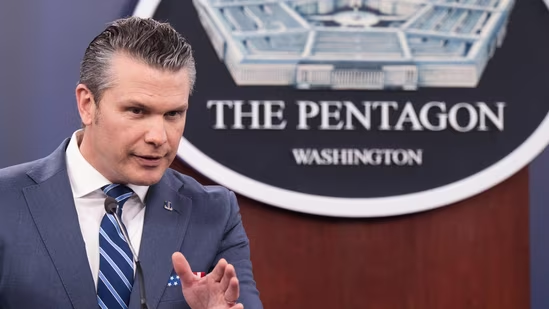
US Defense Secretary Pete Hegseth has come under scrutiny after quoting what he described as a Bible verse during a Pentagon prayer service. It closely resembled a line from Pulp Fiction.
According to reports by Variety and Metro UK, the confusion appears to stem from a misattributed version of scripture popularised by the film.
What happened at the Pentagon?
During a worship service, Hegseth asked attendees to “pray with me” before reciting a passage about a “downed aviator” navigating danger. He linked the prayer to a US combat search-and-rescue mission in Iran, referring to it as “CSAR 25:17.”
“They call it CSAR 25:17, which I think is meant to reflect Ezekiel 25:17,” he said, as quoted by Variety.
Also Read: ‘As long as it takes’: US Pentagon chief Pete Hegseth warns of sustained blockade on Iran ports
The wording he used, however, included extended lines about guiding others “through the valley of darkness” and delivering “great vengeance”: phrasing that mirrors the monologue delivered by Samuel L Jackson’s character in Pulp Fiction.
Where the mix-up came from
The famous speech from the 1994 film, directed by Quentin Tarantino, is itself a fictionalised and expanded version of Ezekiel 25:17.
According to Variety, Hegseth appeared to believe this adapted version had a real-world or military connection, describing it as something associated with rescue missions and linking it back to scripture.
The discrepancy was first flagged by the religion and politics blog A Public Witness.
Also Read: Yassamin Ansari: 5 things about Arizona Democrat who filed impeachment articles against Pete Hegseth
What does the Bible actually say?
As noted by Metro UK, the original biblical verse is much shorter and differs significantly in tone. Ezekiel 25:17 speaks of divine vengeance and judgment, without the narrative elements that have made the film version widely recognisable.
The added lines, including references to shepherding others through darkness, are not part of the Bible, but were created for cinematic effect.
The episode has sparked debate over the use of religious language in official settings, especially when blended with popular culture references.
Hegseth has previously invoked religious imagery in public remarks. At a press briefing, he compared journalists to Pharisees, saying they “were there to witness, to write everything down” but sought to “explain away the goodness,” according to Variety.
The controversy also comes amid ongoing US military involvement in Iran.
It remains unclear whether the quote was used intentionally or mistakenly.