

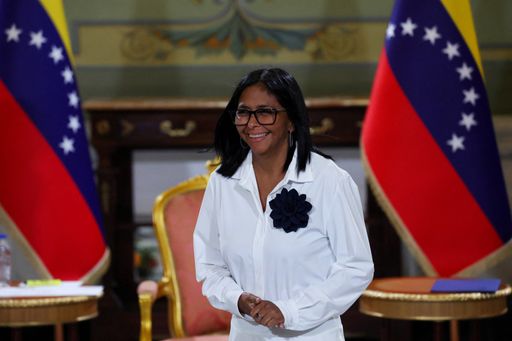
Over three months after US forces captured then-Venezuela president Nicolas Maduro and installed an interim administration under former vice president Delcy Rodriguez, the oil sector of the country with the world’s largest estimated oil reserves is showing first signs of recovery.
Oil exports by Venezuela are now surging as the US-Israeli war against Iran weighs down on global oil supplies.
In particular, oil shipments to US refiners have increased following a selective easing of sanctions that had previously reduced Venezuela’s ability to sell its most valuable commodity on the open market.
The dramatic removal of Maduro, who had ruled for over a decade amid a deep economic crisis, came after US forces abducted him along with his wife in a raid and moved them to New York’s Metropolitan Detention Center to face charges of alleged narco-terrorism.
Afterwards, US President Donald Trump said the US would help “run” Venezuela during a transition period, while announcing a $100 billion reconstruction plan for the country’s energy sector.
The interim government in Caracas has cooperated with Washington over the last three months. As a result, PDVSA, the state-owned oil and gas company of Venezuela, is now able to sell oil more directly to US and international buyers.
Meanwhile, the Trump administration has urged American oil companies to invest heavily in the energy infrastructure of Caracas.
As a result, oil exports, which generated barely $18 billion in 2025, have seen a sharp uptick in the first months of 2026.
However, this rebound is taking place amid Venezuela’s shift away from the long-standing “Bolivarian” project – a social movement launched in 1999 by former president Hugo Chavez to turn the country into a socialist state.
Under the US-backed interim setup, Venezuela is emerging as an investment-friendly destination for American energy giants.
Chevron, which is the only US oil company currently active in Venezuela, along with Exxon Mobil, ConocoPhillips and others, has already demanded that the US government ensure “security guarantees” and an “overhaul of legal and commercial framework” to facilitate investment.
However, experts from across the region say that Venezuelans must reclaim control over their economy to prevent resource wealth from serving US strategic interests at the cost of national development.
They say that Venezuelans must prioritise sovereign control over the economy, as the post-Maduro opening can deepen their dependence on foreign powers.
Related
Sebastian Schulz, a sociologist associated with Argentina’s University of La Plata, tells TRT World that US corporate interests in Venezuela’s energy sector represent a continuation of long-term American efforts to reassert dominance.
“I believe that Exxon Mobil’s demands for security guarantees are part of a broader strategy by US corporations seeking to regain control over Venezuelan oil, which they held until 2007,” he says, while pointing to the nationalisation of the energy sector during Chavez’s 14-year rule.
Schulz links the calls for urgent changes to legal and commercial laws in Venezuela to Trump’s “Make America Great Again” policy, which seeks to reactivate the Monroe Doctrine, a 19th-century political notion that treated Latin America as a “backyard” of the US.
“These statements are, therefore, not naive but part of a broader US strategy aimed at forcibly taking control of the Venezuelan economy by influencing its laws and sovereign decisions, in a context of hegemonic retrenchment,” he says.
Schulz also warns of deeper US aims, such as dismantling national institutions like PDVSA to enable forced asset transfers in the Orinoco Belt, a resource-rich basin in Venezuela that overlies the world’s largest petroleum deposits.
“The US will likely seek to dismantle the institutional framework that allowed Venezuela to regain sovereign control over its strategic assets, not only to appropriate oil resources but also to ensure the installation of an allied government subordinated to US directives,” he says.
Schulz sees no evidence that such interventions benefit local populations, citing Iraq, Libya, and Nigeria as examples in which oil extraction advanced only corporate and geopolitical goals amid political destabilisation, without sustained improvements in living standards.
Related
Venezuela’s inherent resilience
Alfonso Insuasty Rodriguez, director of the GIDPAD research group at Colombia’s University of San Buenaventura, tells TRT World that reforms to Venezuela’s organic hydrocarbons law mean oil remains the property of the state.