
Xi meets Abu Dhabi Crown Prince, outlines four-point peace proposal to ease Middle East tensions

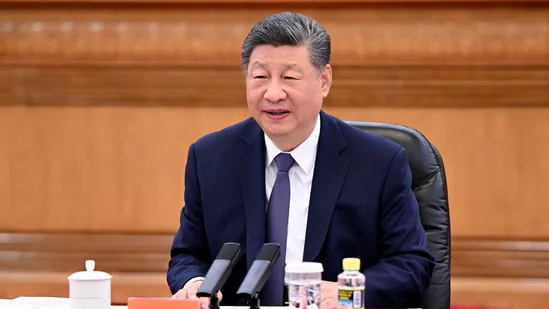
China has outlined a four-point approach to address the ongoing conflict in West Asia, with President Xi Jinping presenting the proposal during a meeting in Beijing with Abu Dhabi’s Crown Prince, Sheikh Khaled bin Mohamed bin Zayed Al Nahyan, Chinese official news agency Xinhua reported.
The proposal comes at a time of heightened regional tensions, following the breakdown of ceasefire talks between the United States and Iran in Pakistan.
Four-points for conflict resolution
During the meeting, Xi emphasised a framework built on four key points:
- Upholding peaceful coexistence
- Respecting national sovereignty
- Balancing development with security
- Safeguarding the international rules-based order
Expanding on the last point, Xi said,”Safeguard the authority of the international rule of law. It can’t be ‘use it when it suits us, discard it when it doesn’t,’ and we cannot allow the world to revert to the law of the jungle.”
Also read | Weapons to Iran: Trump threatens China with 50% tariff, then makes a crude offer
The comments were made during the Abu Dhabi Crown Prince’s visit to Beijing, which comes amid continuing instability in the region.
Xi is also expected to hold talks with Donald Trump in Beijing next month, a meeting that is being closely watched.
Rising tensions in region
The situation in West Asia remains tense after in-person negotiations between US and Iranian officials failed to produce a ceasefire agreement.
Also read | Trump dials Modi amid West Asia war stalemate; need to reopen Hormuz discussed
Iran has shut down the Strait of Hormuz to vessels it considers unfriendly since early March. In response, the US military began a blockade of Iranian ports on Monday, accusing Tehran of engaging in “economic terrorism.”
China plays neutral
Despite US sanctions, Chinese companies have continued to sell to Iran technology that enables it to build weapons. But the Chinese government directly transferring weapons would mark a new level of assistance, CNN noted in its report.
Beijing is reportedly trying to position itself as a continued friend to Iran, whose oil it heavily depends upon, while remaining outwardly neutral.
Sources told CNN that the Chinese could also make the argument that air defense systems are defensive rather than offensive in nature.
This would differentiate their support from that of Russia for Iran. Vladimir Putin’s regime has been providing intelligence to Iran that has helped it proactively target US bases and assets in the Middle East/West Asia.
Iran has been aiding Russia in its war on Ukraine through the provision of Shahed drones, and also sells China the bulk of its sanctioned oil.