

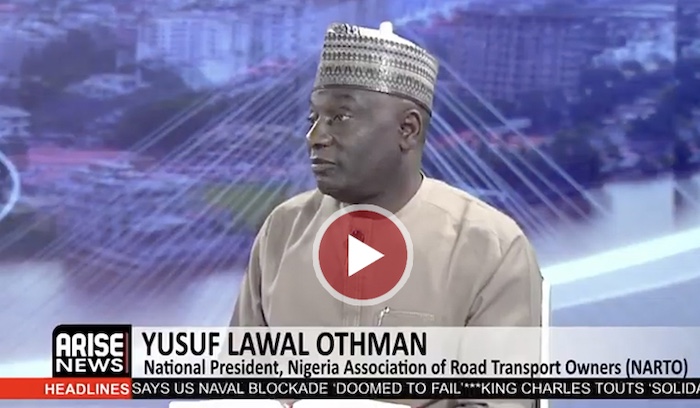
The National President of the Nigerian Association of Road Transport Owners (NARTO), Yusuf Lawal Othman, says the planned deployment of 2,000 Compressed Natural Gas (CNG) trucks by the Lagos State Government to modernise freight movement along the Apapa and Tin Can Island port corridors is facing challenges around financing, cost sustainability, and persistent illegal extortion along transport routes.
Speaking in an interview with ARISE NEWS on Thursday, Othman said the initiative, which is aimed at replacing rickety trucks, improving safety, and restoring order within Nigeria’s busiest logistics corridor, is already in motion but continues to face structural constraints that could limit its full impact.
He noted that while CNG adoption is intended to reduce transport costs compared to petroleum products, fluctuations in energy pricing and broader market realities have affected expected savings.
“The deployment of CNG trucks is supposed to ensure that the cost of transportation, to a large extent, has gone down compared to the escalating cost of other petroleum products,” he said.
He explained that under the federal CNG initiative, transport operators had previously recorded some cost relief, but stressed that price dynamics in the energy sector have influenced outcomes.
“Even before now, like I said, the presidential initiative on CNG—for us, for example, NARTO—gave us quite a number of buses, and by that virtue, 30% of transportation costs went down. And it’s going down everywhere,” Othman said.
However, he noted that rising fuel prices have also affected the cost structure of CNG.
“The issue here is that as the fuel price went up, the CNG itself also went up. So, it’s reflecting the actual cost in the market,” he said.
Othman added that Lagos State’s plan to introduce 2,000 CNG trucks is part of broader efforts to clean up the port access roads and phase out unsafe vehicles contributing to congestion and accidents.
“Lagos State government plans to deploy 2,000 trucks with a view to ensure that some of those rickety trucks plying around the maritime corridor—the ports of Apapa and Tin Can—are replaced so that we have sanity in the system,” he said.
He also referenced similar initiatives in other states, noting that Niger and Kaduna have already adopted CNG buses, with Kaduna even providing free transportation in some cases.
On concerns about resistance from transport operators, Othman said NARTO is not opposed to Lagos State’s reforms but acknowledged that the transition is affecting members whose livelihoods depend on existing trucking operations.
“We don’t so much have opposition as regards the activities of Lagos State government because you have to give it to them. If you follow Lagos closely, you’ll observe that they have done a lot in terms of the railways, they’ve done a lot in terms of the waterways, they’ve done a lot also in terms of some of those BRT buses—they cleared some of the Danfos to some other areas,” he said.
He explained that the shift to new CNG trucks is naturally generating pushback from operators.
“So now they are coming to the truck. And naturally, you would expect some pushback. Some of our members are really pushing back because these trucks have been their sources of livelihood over time,” he said.
Othman added that discussions are ongoing with the Lagos State Government to ease the transition, particularly around financing and credit access.
“As much as they want to bring these 2,000 trucks and they want to help our members, we should look at the cost of these trucks. Because they are going to come at a commercial rate of, of course, UBA has been magnanimous about 24%, but we could go even lower—maybe single digit through BOI, through some of the renewable agenda,” he said.
He stressed that affordability is key to ensuring the success of the initiative.
“We believe that there is a need to ensure that sanity is restored in the system,” he said.
Othman also raised concerns over the activities of non-state actors allegedly extorting transporters along the corridor, calling for stronger enforcement and coordination with security agencies.
“We have a lot of non-state actors extorting most of our members around the corridor,” he said.
He disclosed that discussions have been held with the Senior Special Assistant to the Governor and other stakeholders to address the issue.
“We have discussed with the SSA to the Governor… with a view to ensure that probably we see the new IGP and see how some of these non-state actors who are extorting us will reduce some of the activities they are doing,” he said.
He added that reforms in the tax system are also expected to help reduce multiple and unofficial levies.
“Because we believe with the new Nigeria Revenue Service tax… to ensure all these taxes that are not necessarily legal are removed. Because if you sum it all up, they are really quite exorbitant,” he said.
Responding to concerns that the Lagos State Government had not done enough to address informal taxation and extortion, Othman defended ongoing efforts, noting that reforms are already being implemented.
“The Lagos State government to a very large extent have been doing their very best they can. That was why they took one of us, Bola Adekoya, and gave him SSA to ensure—because he’s appraised of all the activities within the corridor—to ensure that he comes in and brings some succor,” he said.
He also highlighted ongoing interventions aimed at improving welfare and engagement with transport workers.
“The government have done the drivers’ training, driver healthcare, driver eyeglasses changes—all these with a view to get closer instead of ‘carrot and stick’ so to speak. So they are doing all this with a view to bring everybody closer and ensure that some of these things are addressed,” he added.
Boluwatife Enome
Follow us on: