
A new coalition should oust Binyamin Netanyahu

🚨Watch The Full Video ➤

Israel’s election race is, at last, under way. The starting gun was fired on April 26th with the announcement by two former prime ministers, Naftali Bennett and Yair Lapid, that they were merging their parties under Mr Bennett’s leadership. They then hope to build a wider bloc that will replace the government of Binyamin Netanyahu, Israel’s longest-serving leader, in the election expected in October.

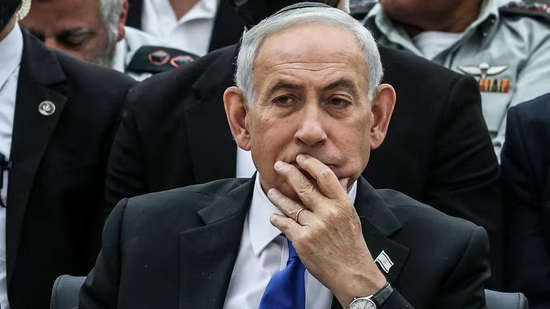
In the past three and a half years Netanyahu’s government, based on a coalition of hard-right and ultra-religious parties, has dragged Israel into a series of costly and inconclusive wars. (REUTERS)

Mr Netanyahu’s opponents should win. In the past three and a half years his government, based on a coalition of hard-right and ultra-religious parties, has dragged Israel into a series of costly and inconclusive wars. It has plunged the country into constitutional turmoil and been tainted by allegations of corruption, including against Mr Netanyahu, who is personally facing charges of bribery and fraud (which he denies). Polls suggest that the coalition lacks the votes needed to win another majority.

Mr Netanyahu, however, has one clear advantage. His camp, fighting to remain in power, remains largely united behind him. The opposition, in contrast, is badly divided. It boasts half a dozen would-be prime ministers and stands for an array of ideologies and constituencies. Building an effective coalition will be difficult. Perhaps optimistically, the new party is called “Together”. And yet, for all their claims of unity, Mr Bennett ruled out including Arab parties, which make up a fifth of Israel’s population, in any future coalition.

Mr Bennett is a right-winger. Mr Lapid is a committed centrist. They are a rare example of political rivals who work well together. After the 2013 election, they formed a tactical bloc in coalition negotiations with Mr Netanyahu, forcing him to appoint both of them to senior roles in his government. In 2021 they achieved the seemingly impossible, building a coalition of right-wingers, centrists, leftists and Islamists that briefly kept Mr Netanyahu out of office.

The pair know that their partnership risks alienating more ideological supporters, and the sum of the merger may be less than its parts. But they are seeking to lessen the fragmentation of the anti-Netanyahu camp. Some point to Hungary, where opposition parties united successfully behind a single centre-right candidate to defeat Viktor Orban. They are casting Mr Bennett as Israel’s Peter Magyar.

But in Israel’s highly polarised society, holding messy coalitions together is a tricky business. Last time Mr Bennett and Mr Lapid were in power, their government lasted barely a year before collapsing under the weight of its contradictions. Then Mr Netanyahu was back.

All this means another election campaign in which Israel’s most fundamental challenges, namely its brutal occupation of the West Bank with its millions of Palestinians and the unresolved plight of Gaza, will not be on the agenda. During his short term as prime minister, Mr Lapid called for the establishment of a Palestinian state. He will not be repeating that soon. At the launch of the new party Mr Bennett vowed to “guard our nation’s land and not give a centimetre to the enemy”.

Instead, Together will focus on the responsibility of Mr Netanyahu’s coalition for the various failures that led to the Hamas attacks of October 2023. It will also berate him for allowing supporters of his ultra-Orthodox allies to remain exempt from military service. This is a sore issue for many Israelis who serve as army reservists, and feel that the burden of the current wars has been grossly unequal.

An electoral system of proportional representation rewards larger parties. To have a decent chance of coming first, the new alliance needs to draw in at least one more partner. The most likely candidate is Gadi Eisenkot, a popular former general whose party has been rising in the polls.

Mr Eisenkot, like other opposition leaders, has been slow to recognise Mr Bennett as his standard-bearer. With the merger, Messrs Bennett and Lapid hope he will find it harder to resist. His decision is likely to determine the course of the race to come.

🚨Watch The Full Video ➤