

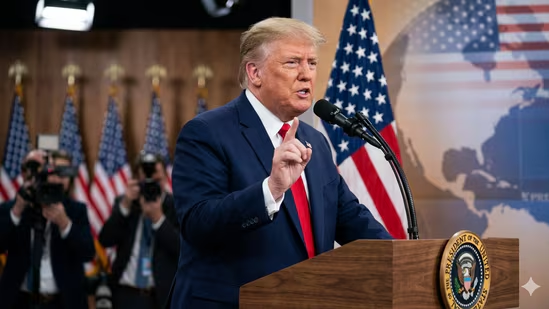
Operation Midnight Hammer was a complete and total obliteration of the Nuclear Dust sites in Iran, said US President Donald Trump on Monday (local time). He added that “digging it out will be a long and difficult process”.
Operation Midnight Hammer was an attack the US launched on Iran in June last year after 12 days of Israel bombing parts of the Islamic Republic over the alleged Iranian nuclear programme. Track Iran war April 21 news here
Saying that media portals “fail to give our great aviators the credit they deserve”, Trump in a post on Truth Social accused them of “always trying to demean and belittle – LOSERS!!!”.
On June 22 last year, the United States Air Force and Navy attacked three nuclear facilities in Iran — Fordow Uranium Enrichment Plant, the Natanz Nuclear Facility, and the Isfahan Nuclear Technology Center — under the code name Operation Midnight Hammer. The US forces used bunker buster bombs that were carried by B-2 Spirit stealth bombers.
The attack was the United States’ official entry in the “twelve-day war”, which began on June 13 with surprise Israeli strikes and ended with the ceasefire on June 24, 2025.
The peace didn’t last very long as the US and Israel launched fresh surprise strikes on Iran on February 28 this year, sparking a full-scale war that rattled the entire Gulf region and closed off key waterway Strait of Hormuz which Iran’s geographical advantage makes it sort of a de facto in charge of.
US-Iran war in limbo
Missiles and drones were exchanged for over a month, pausing only recently with a two-week ceasefire being announced after Pakistan-brokered negotiations between Iran and the US.
With the two-week ceasefire ending on Wednesday, April 22, the United States and Iran each warned they were ready for war as uncertainty prevailed on talks that President Donald Trump had announced would resume in Pakistan.
The White House said Vice President JD Vance was ready to fly back to the Pakistani capital Islamabad, which was preparing for a second round of talks on ending the war that has engulfed the Middle East and shaken global markets.
But Tehran’s cleric-run government declined to confirm that it would participate and accused the United States of violating the truce through its blockade of Iranian ports and seizure of a ship.
“By imposing a blockade and violating the ceasefire, Trump wants to turn this negotiating table into a surrender table or justify renewed hostilities, as he sees fit,” said Iran’s powerful parliament speaker Mohammad Bagher Ghalibaf, who headed the delegations to talks two weeks ago in Pakistan.
“We do not accept negotiations under the shadow of threats, and in the last two weeks we have been preparing to show new cards on the battlefield,” he wrote on X.
Iran’s Revolutionary Guards warned of targeting any vessel attempting to pass through the Strait of Hormuz without permission.
Trump has similarly accused Tehran of violating the truce by harassing vessels in the key strait, the transit passage for about a fifth of the world’s oil that Iran had all but shut in retaliation for the war launched February 28 by the United States and Israel.