

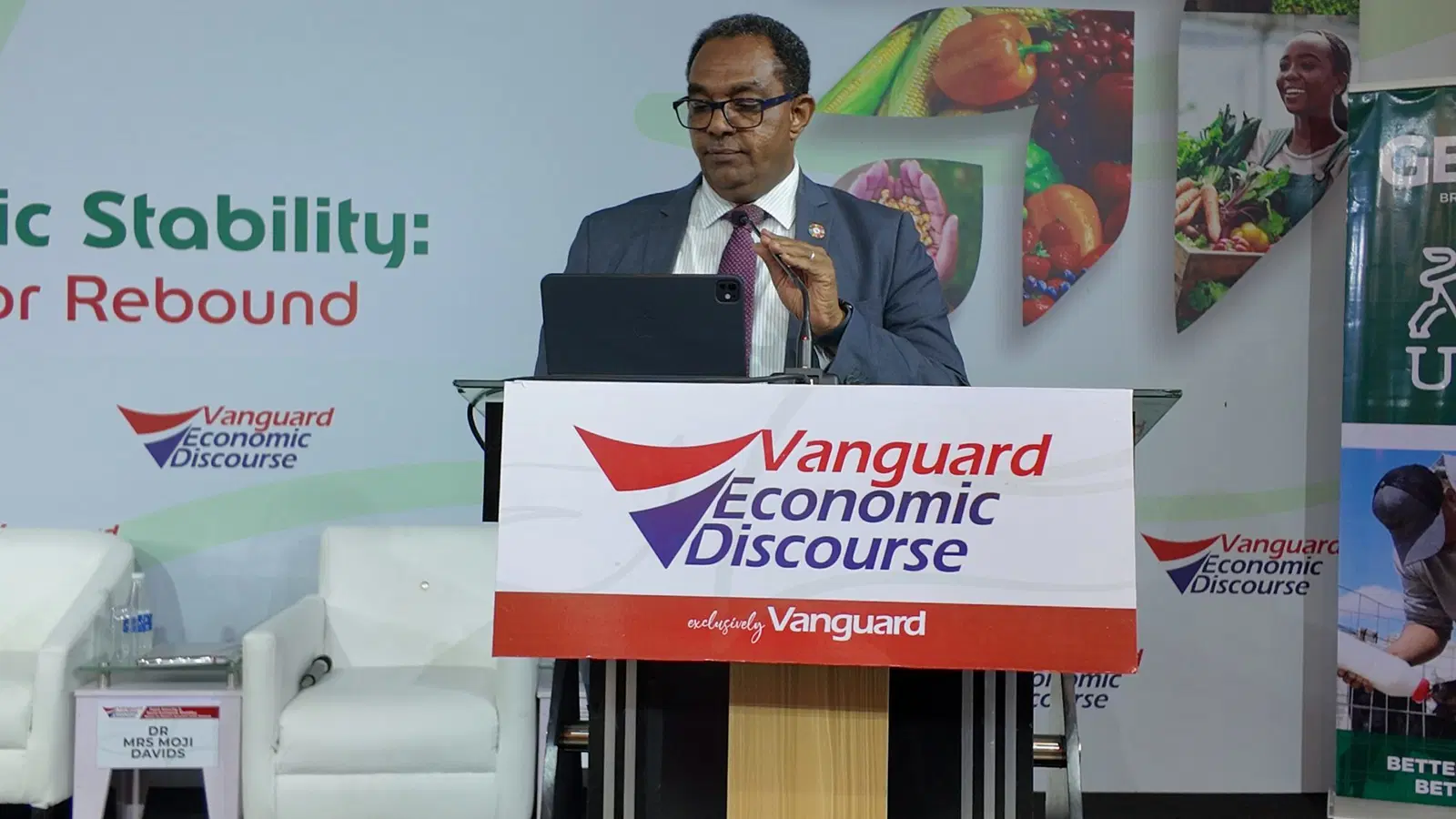
Public and private sector leaders in the agriculture and food sector have indicated massive gap in food security in Nigeria, urging the governments at all levels to take urgent steps to avert major crises ahead.
The leaders drawn from international and local institutions and establishments spoke at the 2026 Vanguard Economic Discourse held yesterday in Lagos, themed, “Food Security and Socio-economic Stability: Options for Nigeria’s Agriculture Sector Rebound”.
Meanwhile, the United Nations’ Food and Agriculture Organisation, UN-FAO, has already projected that the number of Nigerians facing hunger could reach 35.7 million by August this year.
But the International Fund for Agricultural Development, IFAD, has advised that the youth and private sector remain key to ending Nigeria’s food crisis.
The Federal Government, FG, is saying that its new policy set to grow livestock sector to $74billion, while the entire agric value chain is expected to record about $1 trillion in the next 10 years, urging the youth and women to key into the boom.
But the FAO issued a stark warning that Nigeria must urgently overhaul its agricultural financing and technology adoption to avert a looming catastrophe for over 40 million farming households.
Speaking at the Vanguard Newspaper Economic Discourse held in Lagos yesterday, themed, “Food Security and Socio-economic Stability: Options for Nigeria’s Agriculture Sector Rebound”, the FAO Representative in Nigeria and to ECOWAS, Dr. Hussein Gadain, stated: “Food security is far more than an agriculture outcome; it is a pillar of national security, macroeconomic stability, social cohesion, and peace.
“In Nigeria, fragile food systems—affected by conflict, climate shocks, and economic pressures—translate into household vulnerability, deepening poverty, rising social tensions, and inflationary pressures in the economy.”
Addressing the immediate threat to the population, Gadain warned: “In Nigeria, between 27.2 and 35.7 million people are experiencing acute food insecurity in 2025 to August of 2026, concentrated in the North East, North West, and North Central zones, where insurgency, banditry, farmer-herder conflicts, and competition over land and water continue to undermine crop and livestock production.”
On the massive structural trade imbalance draining the nation’s foreign reserves, the FAO chief noted: “Between 2016 and 2019, Nigeria’s cumulative agricultural imports were estimated at about N3.35 trillion—roughly four times higher than agricultural exports of about N803 billion during the same period. This imbalance signals both demand pressures and missed opportunities for domestic value addition, competitiveness, and export growth.”
To reverse this deficit, he argued that the focus must shift to the nation’s 40 million agricultural households.
He explained further: “National data indicate more than 40 million agricultural households, with the majority engaged in crop production (about 36 million), alongside poultry (about 1.45 million) and fish production (about 600 thousand). Any meaningful rebound, therefore, must be designed to work for smallholders—women and men—through improved productivity, risk management, inclusive markets, and strong rural services”.
Advocating for a “New Deal” for these farmers, Gadain emphasized, “A sector cannot rebound without access to finance. Smallholder farmers, pastoralists, and agri-preneurs require affordable credit, insurance, and digital financial services to invest, grow, and manage risk. Scaling climate-smart agriculture, improving access to better seeds, animal breeds, fertilizers, and water management is essential.”
Outlining the path to global competitiveness, he stated: “Priority actions include upgrading market infrastructure, improving logistics and cold chains, enforcing quality and sanitary standards, and expanding agro-processing to shift from raw commodity exports to value-added products. Nigeria is well positioned to play a leadership role under the African Continental Free Trade Area (AfCFTA) by scaling competitive production, supplying regional value chains, and serving as a processing and distribution hub for West and Central Africa.”
He concluded by stressing that the time for action is now: “The rebound we seek is within reach if it is intentional, inclusive, climate-smart, and people-centered. We must seize this moment to turn today’s challenges into tomorrow’s opportunities, ensuring that agriculture once again becomes a driver of prosperity, dignity, and stability for all Nigerians.”
Youths, private sector key to ending Nigeria’s food crisis — IFAD
Speaking at the event, the Country Director of the International Fund for Agricultural Development (IFAD) in Nigeria, Mrs Dede Ahoefa Ekoue, identified youth engagement and stronger private sector participation as critical to ending Nigeria’s deepening food crisis, urging an urgent and coordinated transformation of the nation’s agri-food system.
Ekoue said Nigeria stands at a pivotal moment that requires bold action to unlock opportunities within the food system.
According to her, while food insecurity remains a major challenge, it also presents a pathway for economic growth, job creation and investment if properly harnessed.
Ekoue disclosed that IFAD has invested approximately $1.8 billion in Nigeria, supporting over four million households and enabling smallholder farmers to transition from subsistence agriculture to more profitable participation in structured value chains.
She stressed that smallholder farmers remain central to the country’s food security, noting that their contributions underpin national agricultural output.
Highlighting the role of demographics, Ekoue described Nigeria’s large youth population as a major asset in transforming agriculture, noting that young people possess the innovation, energy and technological capacity needed to drive change across the sector.
She stated: “The transformation we seek will not happen without the youth. They are key to building a food-secure future.” She also emphasised the indispensable role of the private sector, calling for policies and frameworks that reduce investment risks and attract more funding into agriculture.
“We must make the sector more attractive and easier for investors. Without strong private sector involvement, achieving food security will remain difficult,” she added.
Ekoue explained that agriculture should no longer be viewed narrowly as farming but as a broad value chain that includes processing, storage, transportation, marketing and waste management. She noted that this approach opens multiple entry points for youth employment and enterprise development beyond primary production.
She cited IFAD-backed initiatives such as the Value Chain Development Programme, which links farmers in cassava and rice production directly to markets, thereby reducing post-harvest losses and improving incomes.
In addition, she pointed to youth incubation programmes in the Niger Delta, which has trained over 26,000 young people in agribusiness, combining technical expertise with entrepreneurship skills.
Ekoue concluded by stressing the need for stronger alignment among government, investors, farmers and development partners, noting that weak linkages remain a major constraint to progress.
“To achieve real transformation, we must close the gaps and work together. Connection and collaboration are essential to building a resilient and productive agri-food system,” she stated.
New policy will grow livestock sector to $74bn — Livestock Minister
At the backdrop of these the Minister of Livestock Development, Alhaji Idi Muktar Maiha, has said new policies introduced by the Federal Government will grow Nigeria’s livestock sector from its current value of $32 billion to $74 billion within the next 10 years.
Speaking at the 2026 Vanguard Economic Discourse, Maiha who was represented by Engr. Maruf Ajenifuja, stressed that livestock development is central to addressing food insecurity and stabilising the economy.
He stated: “Today, the issue before us is clear: how do we reposition Nigeria’s agriculture to, not only feed our growing population, but also stabilise our economy and unlock inclusive growth potentials?”
He added: “Food security must be treated not just as an agricultural priority, but as a pillar of national security and socio-economic stability.”
Highlighting global pressures, the minister said: “Across the globe, food systems are undergoing profound stress. Climatic variability, inflationary pressures, and rapid population growth are reshaping how nations produce, distribute, and consume food.”
Sponsored
According to him, Nigeria’s challenges are worsened by internal constraints.
He stated: “In Nigeria, these global challenges are compounded by domestic structural issues such as low productivity, weak value chains, infrastructure deficits, and security concerns in key farming areas.”
Maiha emphasised the economic importance of agriculture, noting: “Agriculture contributes about 24 to 26 percent of our GDP and employs close to 35 to 40 percent of the labour force, making it one of the largest sources of livelihood in the country. Yet, we still face persistent food insecurity.”
He warned: “Over 25 million Nigerians are at risk of acute food insecurity, while food inflation has remained above 30 percent, eroding purchasing power and deepening poverty.”
On livestock, the minister said the sector is critical to the transformation agenda. “Livestock contributes about 5 to 8 percent of Nigeria’s GDP and accounts for nearly one-third of agricultural GDP. Beyond these figures, it plays a vital role in nutrition, particularly in addressing protein deficiency.”
He noted that consumption levels remain low: “Average per capita animal protein intake in Nigeria is about 7 to 10 grams per day, far below the recommended minimum of 20 grams.”
Despite large animal numbers, productivity remains weak. “Nigeria has about 58.7 million cattle, 60.2 million sheep, 107.8 million goats, and 695 million chickens. Yet productivity is low due to constraints in feed availability, genetics, animal health systems, and market infrastructure.”
To address this, Maiha said the government has introduced a comprehensive reform framework. “We have instituted the Nigerian Livestock Growth Acceleration Strategy with 10 pillars designed to transform the sector from $32 billion to $74 billion by 2035.”
He explained key priorities: “Feed and fodder development is critical because feed accounts for about 70 percent of production costs. We must invest in cultivated pastures, silage systems, and integrated crop-livestock models.”
He also stressed the need to strengthen value chains. “Post-harvest losses in Nigeria are estimated at 30 to 40 percent for perishable commodities. This represents significant economic losses that must be addressed.”
On financing and security, he said: “Access to agricultural financing remains a major challenge, while farmers and pastoralists cannot operate effectively in insecure environments. These issues must be tackled urgently.”
The minister highlighted the role of technology: “Digital solutions such as precision farming, livestock identification systems, disease surveillance tools, and digital extension services can transform agriculture.”
Calling for investment, Maiha said: “The scale of transformation required cannot be driven by government alone. We need strong private sector participation and large-scale investment in agriculture.”
He urged immediate action: “It is time to move from dialogue to action. This must translate into investment-ready projects, strategic partnerships, and measurable outcomes.”
With Nigeria’s population projected to exceed 250 million by 2030, he warned of rising demand pressures. “If we act decisively, agriculture can become a driver of economic diversification, mass employment, and national security. Failure to act will result in rising hunger, poverty, and social instability.”
Don’t miss $1trn agro boom, Agric Minister charges youths, women
Meanwhile, the Minister of Agriculture and Food Security, Senator Abubakar Kyari, has urged Nigerian youths and women not to miss out on the $1 trillion agribusiness boom projected for Africa by 2030, calling on them to take advantage of emerging opportunities in the sector and position themselves for future wealth creation.
Speaking at the event Kyari, who was represented by Prof. Eustace Iyayi, stressed that “the future belongs to those who start now,” adding, “a nation with over 70 percent youth population has an asset to deploy.”
He called on young Nigerians and women across communities to key into agribusiness, insisting that “if you’re looking for the sector to invest in, that is agriculture.”
Highlighting the scale of opportunity, he said: “This is a sign of a resounding projection that the size of food and agribusinesses in Africa by the year 2030 will be over $1 trillion. The nation is advising the youths today. The future belongs to those who start now.”
However, the minister raised concerns about the sector’s weak financing structure, noting that “the estimated cost of financing agriculture through financial institutions, which stands at about N3.4 million or N2 million, represents less than four percent of the sector’s contribution to GDP.”
He warned that “this shortfall highlights the massive deficits in agricultural financing, which continue to hinder growth and investment in the industry.”
Despite the challenges, Kyari maintained that the government is taking decisive steps to reposition agriculture as a major driver of economic growth.
He disclosed that “the Federal Ministry of Agriculture and Food Security is implementing flagship projects in collaboration with states, especially a $538 million Special Agro-Industrial Processing Zone initiative, the largest in Africa.”
Elaborating on this effort during the panel session at the event, the minister said, “The project which is being currently implemented in eight locations will expand to 27 more states, creating hubs where investors can establish processing plants and seamlessly connect to markets.” He added that “to complement these efforts, the ministry is also investing in rural infrastructure, including road construction to link farms with markets,” noting that “by providing catalytic funding and inviting private sector participation, the government is building an investment platform that transforms agriculture into a driver of industrial growth.”
Kyari described the initiatives as transformative, stating: “These initiatives mark a bold step toward food security, economic empowerment, and sustainable development.
As policy leaders, our role is to set a clear direction that empowers states to align with national priorities and amplify impact at the grassroots level.”
Placing strong emphasis on youth inclusion, he said: “One critical area of focus is youth engagement. For the first time in a decade, the minister has appointed a special assistant dedicated to youth and agribusiness, signaling a renewed commitment to harnessing the energy, creativity, and potential of our young population.”
He continued: “This step ensures that youth are not just included but prioritized in shaping the future of food security and agricultural transformation,” adding that “with over 70 percent of our population made up of youth, the opportunity before us is immense.”
Kyari further noted: “By channeling their dynamism into agribusiness, we can transform this demographic into a powerful asset—the heartbeat of our green revolution,” stressing that “this vision positions youth as the backbone of sustainable growth, ensuring food security, economic empowerment, and a brighter future.”
On support for farmers, Kyari revealed that “in response to rising input costs threatening smallholder farmers, the Federal Ministry of Agriculture and Food Security has distributed over two million packs of fertiliser through state governments.”
He explained that “this partnership approach recognizes that land belongs to the states and agriculture falls under the concurrent legislative list.”
According to him, “by empowering states, which are closest to the farmers, the ministry ensures that support reaches those who need it most, strengthening food production and rural livelihoods.”
Reiterating the broader vision, Kyari concluded: “If we succeed, this will not just be a policy achievement but the circle of fortune that defines our nation’s prosperity for generations to come.
SPONSORED