

Big American companies are piling up profits despite war and consumer anxiety, bolstered by healthy sales growth.
With just over one-fourth of S&P 500 companies reporting results for the first quarter, Wall Street’s expectations for earnings suggest big U.S. companies are far healthier than wider economic concerns might indicate.
“Earnings growth has been exceptional,” said Parag Thatte, an equity strategist for Deutsche Bank. “We’re seeing the broadening of earnings growth beyond just tech and financial” firms.
War in the Middle East had led economists to rein in growth projections for the year. Consumers—long the engine of the U.S. economy—feel solidly in the dumps. High oil prices act like a tax, dragging down household consumption while boosting inflation.
Yet the biggest U.S. public companies are seeing profit and revenue surge. Year-over-year growth in earnings per share is expected to exceed 13% for the sixth quarter running, according to estimates from financial-data firm LSEG. Sales are expected to rise more than in any quarter since the fall of 2022.
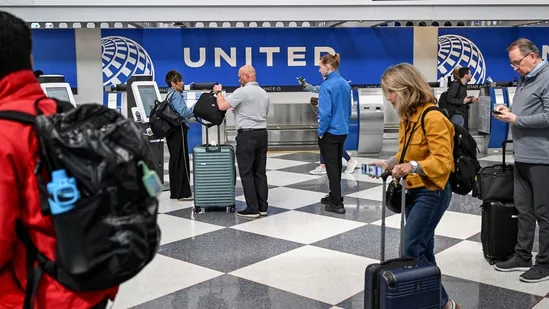
Even some airlines, slammed by jet-fuel shortages and fuel prices driven up by the Iran war, are thriving. United Airlines Holdings’ profit rose 80% from the first quarter of last year, as sales for basic economy seats increased 7% and sales for premium offerings, such as seats in first class or with extra legroom, rose 14%. Business travel is up 25% in recent weeks, after growth of 16% and 9% in recent quarters, the company said.
The airline cut its profit outlook for the year and has reduced capacity, but it expects travel demand to stay strong enough that it can raise fares as much as 20%, recouping all its higher jet-fuel costs by early next year, the company said.
“The price increases are going well and demand is hanging in there really strong,” Chief Executive Scott Kirby told investors last week.
For much of the S&P 500, margins are improving. The gap between profit and sales growth remains below late-2024 highs, suggesting real expansion behind much of the profit growth, in addition to cost cutting, productivity improvements and other efficiency gains.
Another notable development: Rising earnings are getting the smallest assist from share buybacks that they have in many quarters. When companies buy back shares, they boost their earnings-per-share figure without actually raising net income—the bottom line. The difference between those two measures of profit is now at its smallest in more than two years, a gap of just under 1 percentage point, or half what it was six months ago.
The bright outlook isn’t uniform. Earnings growth is expected to reach 48% for tech companies, with revenue rising 28%, although market watchers debate whether the money poured into artificial-intelligence chips and data centers can be sustained. The financial and materials sectors also outpaced overall gains, while energy companies, so far, show earnings down from this time last year on tepid sales growth. But the sector’s outlook is favorable, thanks to volatile energy prices and the prospect of oil shortfalls in parts of the world.
Sales and profit eclipsed Wall Street expectations at Halliburton, the Houston-based global oil-services company. The energy landscape changed meaningfully in just 60 days and now companies are racing to invest from Norway and Nigeria to Argentina and Brazil, CEO Jeff Miller told investors and analysts last week.
“Energy security is no longer simply a talking point,” he said. “It demands action by every nation to ensure a reliable supply of oil and gas.”
But high prices at the pump are feeding Americans’ overall dour mood. U.S. consumer sentiment hit a record low in April, dragged down by worries about the Iran war, gas prices, job risks from AI and more. Across ages, incomes and political opinions, today’s grim perception of the economy is darker than during any previous crisis since the University of Michigan started tracking sentiment more than 50 years ago, said Joanne Hsu, the survey’s director.
Earnings growth at consumer companies in the first quarter is expected to lag behind the rest of the S&P 500, at 2.4% for the consumer-discretionary sector and 3.4% for consumer staples. LSEG’s figures include reported results for just over a quarter of the S&P 500 and analyst estimates for the remainder.
“The consumer sectors are the weak link so far. We haven’t really seen strong growth,” Deutsche Bank’s Thatte said, adding that companies tend to blame consumers when weakness might have more to do with their own operations.
Consumer-products company Procter & Gamble, which sells brands including Tide, Crest, Puffs and Pampers, reported sales growth of 3%, below what it considers a normal rate of 4%.
“The consumer is still a little bit muted,” said Andre Schulten, P&G’s chief financial officer. But larger tax refunds were a “bright spot” for Americans that boosted disposable income, he added.
Overall consumer spending appears robust. American Express reported cardholder spending was up 9% in the first quarter, to a three-year high. Luxury retail spending rose even more, at 18%, while air-travel spending increased 8%, constrained by travel disruptions related to the Middle East conflict.
Americans don’t appear to be holding back because of the specter of AI displacing white-collar jobs, American Express CEO Stephen Squeri said. “We’re not seeing any impact at all.”
Spending among cardholders aged 45 and younger was strong and increasing—though not uniformly, he added. “It’s not every millennial and Gen Z. It’s the cream of the crop.”
In the current K-shaped economy, the wealthy keep spending, while most everyone else feels strapped. That means strong results at some companies and in some sectors are masking weaker results elsewhere, said Gregory Daco, chief economist at EY-Parthenon.
“On average, profits look good,” Daco said. “On average, the economy looks good. But when you look at who is benefiting from that growth, it’s extremely polarized.”
Smaller companies and those that are consumer-facing are hit harder by tariffs and energy-price hikes, while those with less versatility or smaller budgets have more trouble navigating the disruption of AI adoption, Daco said.
Charter Communications’ stock plunged 25% on Friday after the company reported losing 120,000 internet subscribers and other video customers as people keep cutting cable cords in favor of cheaper streaming options.
Bigger companies and those with business customers are generally doing better, Daco said: “It seems like we will be in a winner-takes-all type of environment.”
Write to Theo Francis at theo.francis@wsj.com